

Structured Cabling
Structured Cabling Explained: The Foundation of Reliable Network Infrastructure

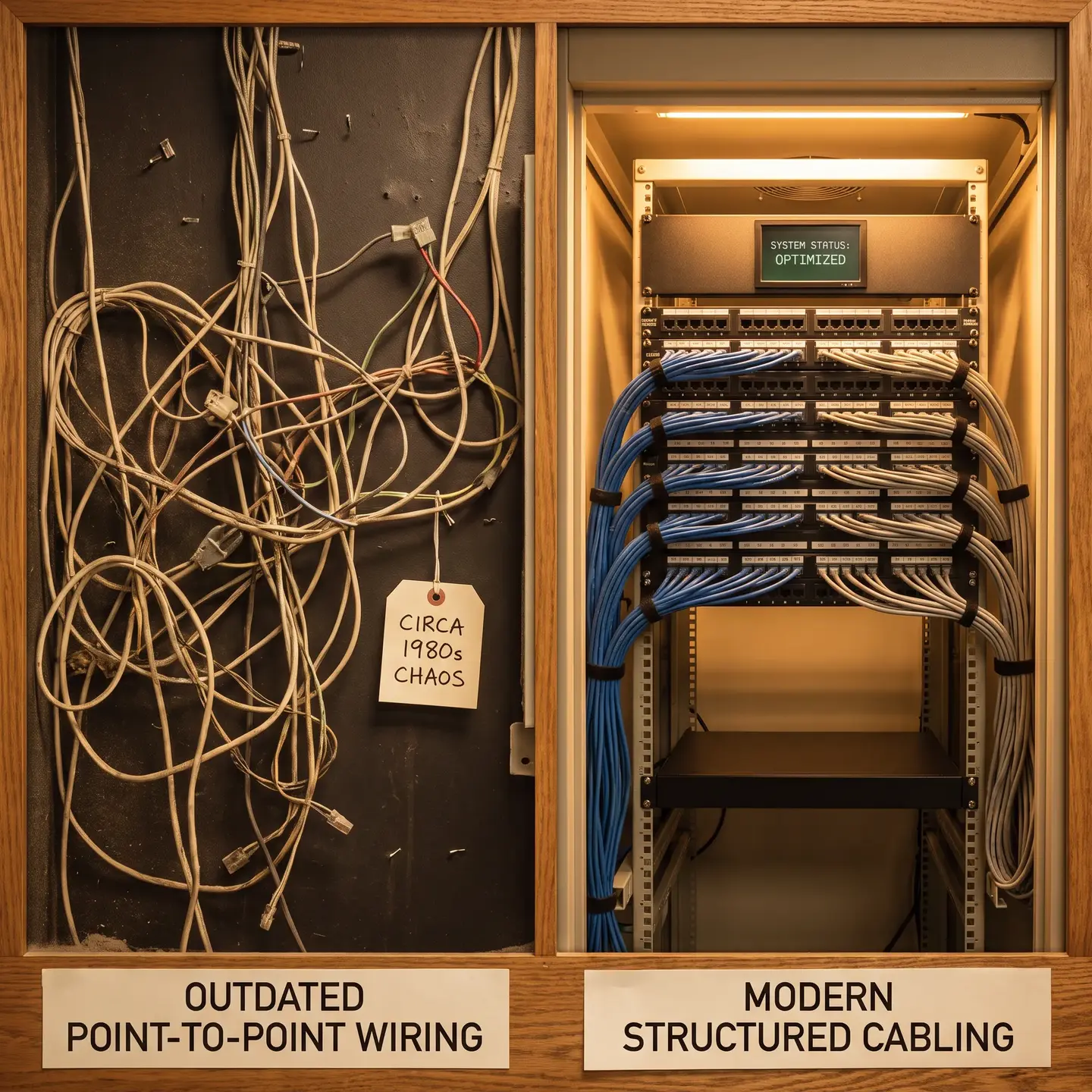
We’ve seen it happen more times than we can count: a property director brings us in to upgrade their building’s security cameras, only to discover that the network cabling installed just a few years ago can’t handle the power and bandwidth requirements of modern IP devices. What seemed like a routine camera upgrade becomes a full cabling retrofit project, with walls opened, ceilings disturbed, and costs multiplied. The original cabling looked fine—it was in the walls, it connected to ports, lights blinked on the switches. But it wasn’t structured cabling. It was point-to-point wiring done by whoever was cheapest at the time, and now that facility is paying for that decision.
This scenario plays out in commercial buildings across Canada every week. And it’s why we’ve dedicated this article to explaining what structured cabling actually means, why it matters for your facility’s long-term technology capabilities, and how to evaluate cabling proposals so you don’t end up in the same position three years from now.

Who This Article Is For (And Who It Isn’t)
This article is written specifically for facility managers, property directors, building owners, and IT directors who make decisions about building infrastructure—but who aren’t necessarily network cabling specialists. If you’ve seen “structured cabling” in vendor proposals and wondered how it differs from regular electrical work, or if you’re trying to understand why one cabling quote is three times higher than another, you’re in the right place.
This isn’t a technical manual for network engineers or a certification study guide. We’re translating telecommunications industry concepts into business terms so you can:
- Understand what you’re actually buying when you approve a cabling project
- Recognize the difference between quality infrastructure and minimum-viable installation
- Ask the right questions when evaluating vendors
- Make cabling decisions that won’t constrain your technology options for the next two decades
What Structured Cabling Actually Means (And Why “Just Running Cables” Fails)
At its simplest, structured cabling services refers to a standardized approach to designing and installing network cabling infrastructure. Instead of running individual cables directly from each device to a central point (point-to-point wiring), structured cabling uses an organized hierarchy of components that work together as a system.
Think of it this way: point-to-point wiring is like running extension cords from every appliance in your building directly to the electrical panel. It might work initially, but adding new appliances becomes increasingly chaotic, troubleshooting problems requires tracing spaghetti, and eventually the whole system becomes unmanageable. Structured cabling is like having a proper electrical system with a panel, circuits, outlets in standard locations, and the capacity to add devices without rewiring the building.
The key differences that matter for facility operations:
- Scalability: Structured systems let you add, move, or change devices by patching cables at distribution points rather than pulling entirely new cable runs
- Standardization: Components follow industry specifications, meaning equipment from different manufacturers works together and future technology upgrades remain possible
- Documentation: Every cable, port, and connection point is labelled and mapped, making troubleshooting and modifications straightforward rather than archaeological excavations
- Testability: Performance can be certified against known standards, proving the infrastructure will support specified speeds and power delivery
The building with “just cables in the walls” may appear functional, but when you need to deploy modern PoE-powered IP camera systems or upgrade network speeds, you often discover those cables can’t deliver what today’s technology requires.
The TIA-568 Standard: What It Guarantees and Why Compliance Matters
When we talk about structured cabling standards, we’re primarily referring to TIA-568 telecommunications cabling standards in North America, along with ISO/IEC 11801 internationally. These standards aren’t arbitrary bureaucratic requirements—they’re specifications developed over decades to ensure that cabling infrastructure reliably supports networking technology.
What TIA-568 compliance actually guarantees for your facility:
- Interoperability: Equipment from any standards-compliant manufacturer will work on your network. You’re not locked into proprietary systems that only function with specific vendor hardware.
- Performance predictability: Cables tested to TIA standards deliver documented speeds and power capacity at specified distances. No guessing whether infrastructure can handle new technology.
- Future compatibility: Standards are designed with forward compatibility in mind. Cabling installed to current specifications typically supports multiple generations of equipment upgrades.
- Warranty protection: Manufacturer warranties typically require standards-compliant installation. Non-compliant work may void coverage when problems emerge.
For vendor evaluation, BICSI standards and installer certifications provide the professional framework that advances these standards and certifies installers. When evaluating cabling contractors, BICSI credentials (like RCDD—Registered Communications Distribution Designer) indicate specialized training in structured cabling design and installation practices.
Non-compliant installations often work initially—which is precisely the problem. They fail when you upgrade switches, add PoE devices, or attempt to support higher speeds. By then, the original contractor has moved on, and you’re left with the retrofit bill.
Components of a Structured Cabling System: What You’re Actually Paying For
Understanding the components of structured cabling helps you evaluate proposals intelligently. The system breaks into six functional subsystems, each serving a specific purpose in your facility:
Entrance Facility
This is where external services (internet, telephone, cable) enter your building and connect to internal infrastructure. It typically includes demarcation points where service provider responsibility ends and yours begins, plus protective equipment to shield internal systems from external electrical events.
Equipment Room
The centralized location housing major network hardware—servers, core switches, security system head-ends, and similar infrastructure. In larger facilities, this room requires specific environmental controls (cooling, power conditioning) and physical security.
Backbone Cabling
Vertical cabling connecting floors and buildings to the main equipment room. Think of this as the highway system for your network traffic. Backbone capacity determines whether you can add floors to your network or increase bandwidth between buildings without replacing vertical infrastructure entirely.
Telecommunications Room
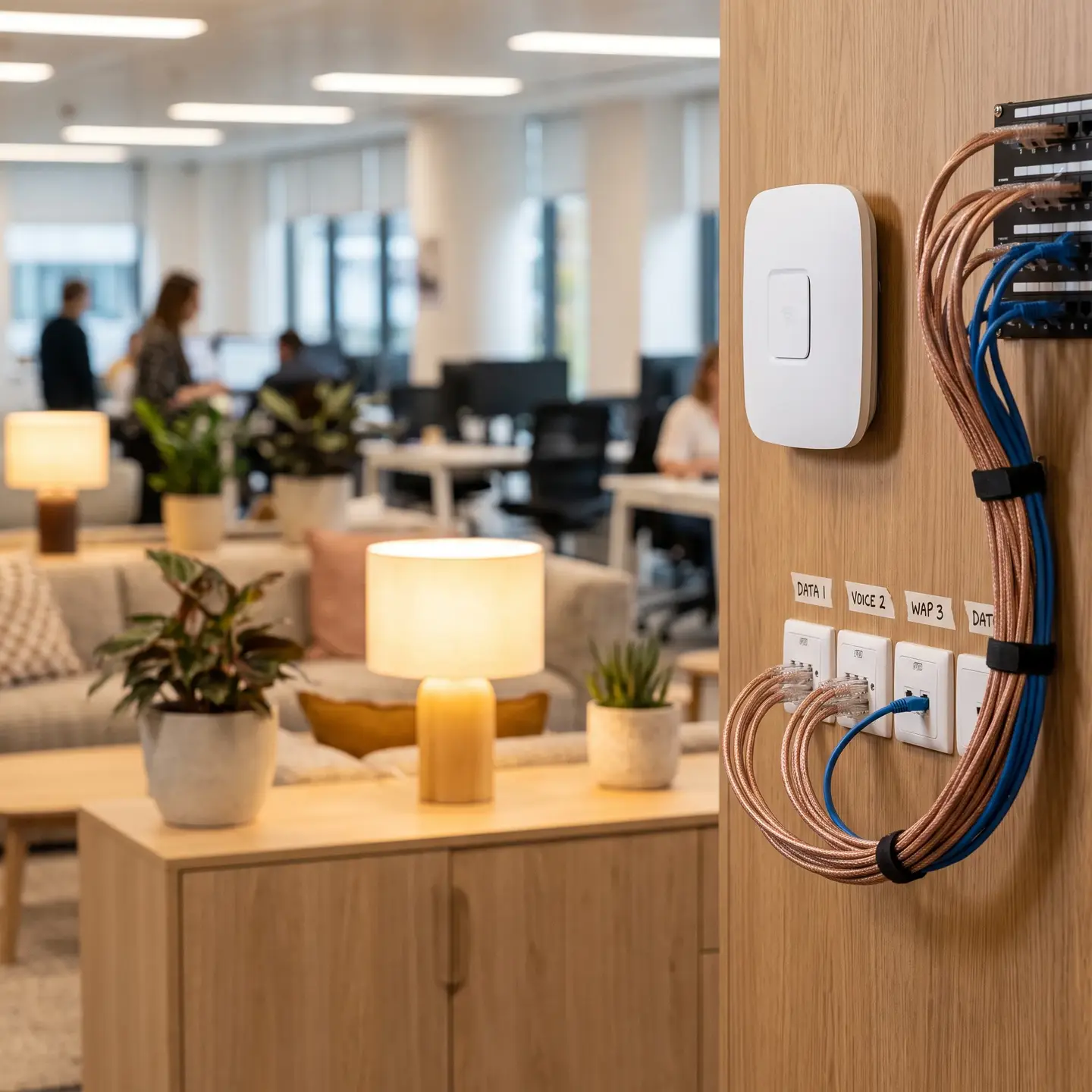
Distribution hubs located on each floor or zone of your building. These rooms contain switches and patch panels that distribute connectivity to work areas. Their strategic placement allows you to reconfigure office layouts without pulling new cables from the basement—you’re simply re-patching at the floor distribution point.
Horizontal Cabling
The cables running from telecommunications rooms to individual outlets throughout the floor. This represents the majority of cable in most installations and follows specific pathway and distance rules to ensure reliable performance.
Work Area
The connection points where devices actually plug in—outlets, patch cords, and the final few meters to computers, phones, cameras, and access control devices.
When reviewing a cabling proposal, you should see these components specified with cable categories, pathway methods, and testing requirements. Vague descriptions like “network cabling throughout” should prompt questions about exactly what’s being installed and how.
How Cabling Category Affects Your Technology Options
Cable category ratings determine what your infrastructure can actually support. This isn’t abstract specification—it directly affects whether you can deploy the technology your operations need.
Category 5e: Supports gigabit Ethernet at 100 meters. Adequate for basic data networking but increasingly inadequate for modern demands. Can struggle with higher-power PoE devices (cameras, access control readers, WiFi access points) at longer distances due to heat buildup affecting performance.
Category 6: Supports gigabit Ethernet reliably and 10-gigabit Ethernet at shorter distances (up to 55 meters). Better PoE performance than Cat5e. A reasonable baseline for many current applications.
Category 6A: Supports 10-gigabit Ethernet at full 100-meter distances. Designed for high-power PoE applications. This category has become the standard recommendation for new commercial installations because it accommodates current and foreseeable technology needs.
Here’s where this matters practically: if you’re planning to deploy modern access control systems with IP-connected readers, high-resolution security cameras with onboard analytics, or WiFi 6 access points throughout your facility, inadequate cabling becomes a hard constraint. The devices require specific power and bandwidth that lower-category cabling simply cannot deliver at commercial distances.
We regularly encounter facilities where the cabling installed five years ago now prevents technology upgrades without costly retrofits. The original installer used Cat5e because it was cheaper, and now every camera and access point location needs new cabling to support current equipment specifications.
The 15-Year Infrastructure Decision: Why Initial Quality Compounds
Unlike IT equipment that refreshes every 3-5 years, cabling infrastructure remains in your walls and ceilings for 15-25 years. Industry warranty benchmarks reflect this reality—quality manufacturers back their systems for decades precisely because properly installed cabling should last that long.
This extended lifespan creates a compounding effect where initial installation quality either pays dividends or extracts costs over time:
Poor initial installation leads to:
- Intermittent network issues from failed terminations consuming IT troubleshooting hours
- Premature replacement when inadequate cable categories can’t support technology advances
- Discovery projects for every move/add/change because documentation is absent or inaccurate
- Vendor finger-pointing when problems arise and installation records don’t exist
- Retrofit costs that often exceed what proper initial installation would have cost
Quality initial installation creates:
- Invisible infrastructure that simply works across multiple technology generations
- Straightforward modifications because documentation shows exactly what exists where
- Warranty protection when problems do occur
- Reduced operational overhead from fewer troubleshooting incidents
- Flexibility to adopt new technology without infrastructure constraints
When evaluating proposals, consider total cost of ownership over 15+ years, not just initial installation price. The cheapest proposal often becomes the most expensive infrastructure when retrofit costs emerge.
When to Engage a Structured Cabling Specialist
A common misconception we encounter: “Any electrician can run network cables.” This thinking creates many of the problem installations we’re called to remediate.
Structured cabling requires specialized knowledge that general electrical contractors typically don’t possess:
- Understanding of telecommunications standards and testing requirements
- Certification equipment capable of documenting performance to TIA specifications
- Knowledge of cable pathway requirements, bend radius limitations, and termination standards
- Experience with PoE power calculations and distance limitations
- Familiarity with integration requirements for security systems, access control, and other specialized applications
Poor installations often pass visual inspection but fail performance testing. Cables may be connected, lights may blink, basic traffic may flow—but the infrastructure operates at the edge of acceptable parameters. Problems emerge months later when you add devices, increase traffic, or deploy technology that requires full cable capacity.
For our part at Ainger, we function as both a security systems integrator and a standalone Cabling contractor. Facility managers engage us for office network infrastructure, data centre cabling, or facility-wide deployments independent of security projects. The advantage: our technicians understand both telecommunications standards and security-specific wiring requirements, eliminating coordination problems when cabling needs to support integrated systems.
Evaluating Cabling Proposals: A Practical Framework
When you receive cabling proposals, use this framework to distinguish quality contractors from minimum-viable installers:
Installer Credentials to Verify
- BICSI certifications (RCDD, TECH, or similar) indicating formal structured cabling training
- Manufacturer authorizations that enable warranty coverage
- Insurance and bonding appropriate for commercial work
- References from comparable commercial projects (not residential installations)
Documentation to Request
- Detailed scope specifying cable categories, pathway methods, and component specifications
- Testing protocol description—how will installed cabling be certified to TIA standards?
- As-built documentation commitment—what records will you receive at project completion?
- Labelling conventions that match your facility management requirements
Warranty Terms to Negotiate
- Manufacturer system warranty (typically 15-25 years from quality vendors)
- Installer workmanship warranty (what defects are covered and for how long?)
- Service response commitments if problems emerge
- Clear delineation of what voids warranty protection
Red Flags to Watch For
- Vague specifications (“network cabling” without category and pathway details)
- No mention of testing or certification documentation
- Significantly lower pricing without clear scope differences
- Resistance to providing installer credentials or references
- Proposals that don’t address documentation deliverables
Making the Infrastructure Investment Decision
Structured cabling isn’t the most visible part of your building’s technology infrastructure—it’s hidden in walls, above ceilings, and below floors. But it’s the foundation that everything else depends on. Your security cameras, access control systems, network connectivity, and future technology adoptions all rely on this infrastructure performing reliably for decades.
The decision you make today about cabling quality will affect your facility’s operational capabilities and technology costs for the next 15-25 years. We’ve seen facilities where quality initial installation enabled seamless technology evolution across multiple equipment generations. And we’ve seen facilities where corner-cutting created compounding problems that eventually cost more to remediate than proper installation would have originally.
When you’re ready to discuss cabling infrastructure for new construction, tenant fit-outs, or facility upgrades, we’d welcome the conversation. Whether that’s a standalone cabling project or part of an integrated security system deployment, understanding your facility’s long-term needs comes first—the technical specifications follow from there.
Frequently Asked Questions
Higher quotes usually include standards-compliant design, certified testing, proper documentation, and higher cable categories like Cat6A installed by trained specialists. Cheaper quotes often mean minimal specs, no testing, limited documentation, and cable categories that will need replacing when you upgrade technology.
For most modern commercial buildings, Cat6A is the safer baseline because it supports 10 Gb Ethernet at full distances and high-power PoE. Cat5e and basic Cat6 may work today but often become a hard limit when you deploy higher-resolution cameras, WiFi 6, or IP access control devices.
Look for specific cable categories, pathway methods, and components; a clear testing and certification plan to TIA standards; BICSI-certified installers; defined documentation and labelling deliverables; and long-term manufacturer and workmanship warranties. Vague “network cabling throughout” language is a red flag.
Structured cabling is a standardized, documented system with defined components, pathways, and testing—not just point-to-point cables pulled wherever they fit. It’s designed for scalability, easier troubleshooting, and long-term compatibility with future IP devices, PoE, and higher network speeds.
General electricians often make it work visually but may ignore telecom standards, PoE limitations, pathway rules, and certification testing. That can lead to cabling that passes a quick inspection but fails under real-world loads when you add cameras, access control, or higher-speed networking.