
Commercial Surveillance Cameras
for Business Environments
How to Choose Commercial Surveillance Cameras for Your Facility
SELECTING THE RIGHT CAMERA FOR EVERY ENVIRONMENT
Choosing the right commercial surveillance cameras is not about finding the highest resolution or the most expensive model. It is about matching camera capabilities to the specific conditions each camera will face: lighting, distance, weather exposure, mounting height, and what the footage actually needs to capture.
Ainger Cabling + Security installs commercial surveillance cameras from Uniview and Avigilon, both manufacturer-authorized brands with factory-backed warranties. Our technicians assess your facility’s environments during the site survey and recommend camera types, resolutions, and lens configurations that deliver usable footage under real-world conditions, not just specifications that look good on a data sheet.
This page covers the camera types, specifications, and environmental factors that determine whether your surveillance system produces evidence-grade footage or unusable images. For information on the full surveillance system including recording, management software, and integration, see our CCTV camera systems page. For sites that need trained operators watching the cameras after hours, 24/7 live CCTV monitoring is available as a paid add-on.

What Types of Commercial Surveillance Cameras Are Available?
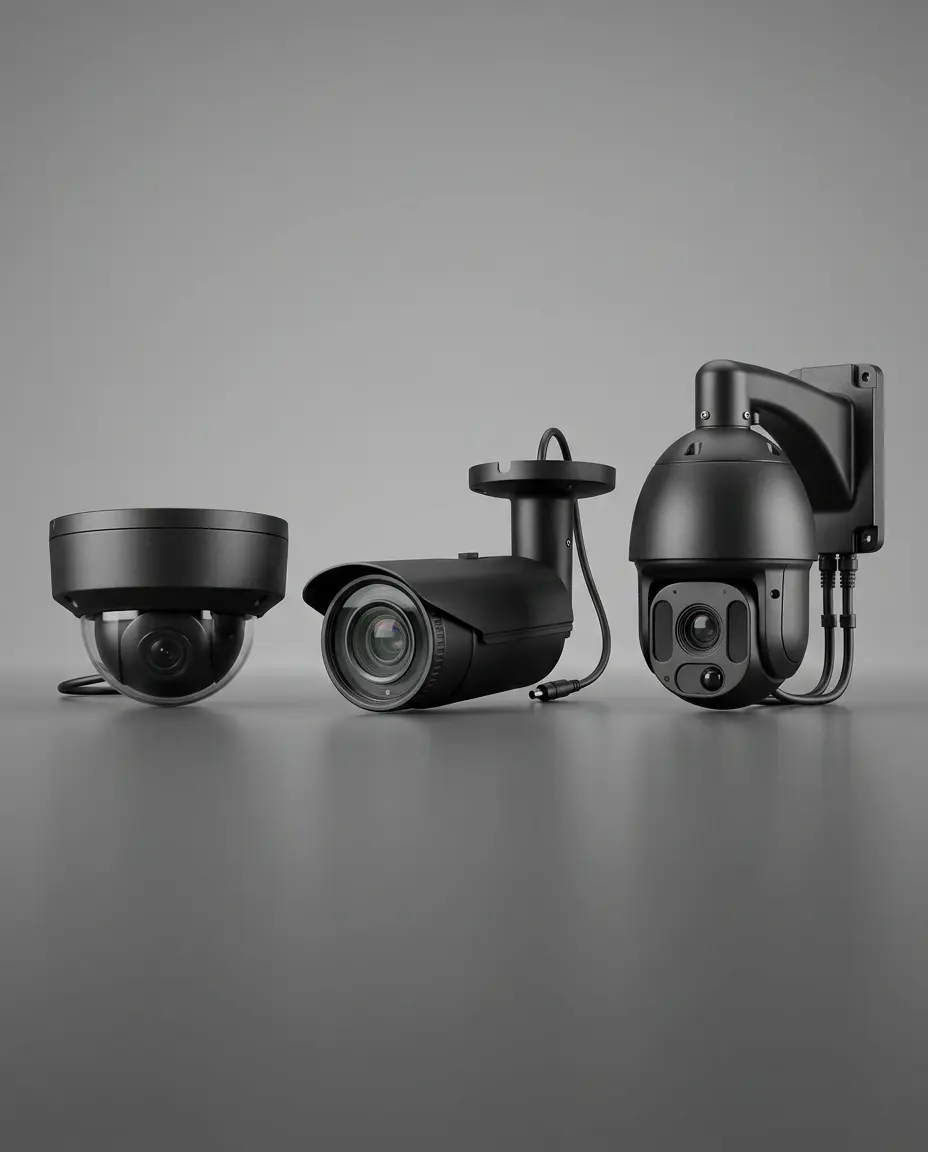
Each camera form factor is designed for specific mounting positions and coverage patterns. Choosing the wrong type for a location means either blind spots or wasted resolution:
- Dome cameras mount flush to ceilings and provide wide-angle coverage in a compact, vandal-resistant housing. They are the most common commercial interior camera and work well in offices, lobbies, hallways, and retail environments where discreet appearance and tamper resistance matter.
- Bullet cameras use a cylindrical housing with a focused, longer-range lens. They are designed for outdoor perimeters, parking lots, loading docks, and building exteriors where weather resistance and visible deterrence are priorities. The housing design naturally sheds rain and snow.
- PTZ cameras (pan-tilt-zoom) provide remote-controlled directional coverage with optical zoom capability. They serve large open areas like warehouse floors, parking structures, and campus environments where operators need to follow activity or zoom into specific areas in real time.
- Turret cameras offer a ball-and-socket design that allows flexible angle adjustment after mounting. They combine the low profile of a dome with easier installation and are commonly used in commercial interiors and semi-protected exterior locations.
- Multi-sensor cameras use multiple image sensors in a single housing to provide panoramic or 180/360-degree coverage. They replace three or four individual cameras at intersections, open office layouts, and large facility entrances, reducing camera count and cabling requirements.
What Camera Specifications Matter for Commercial Surveillance?
Camera specifications determine whether your footage is useful for identification and investigation or just a blurry record that something happened:
- Resolution. 2MP (1080p) provides adequate identification at close range. 4MP and 5MP cameras deliver sharper detail across wider areas. 4K (8MP) is reserved for high-value zones where facial detail and licence plate recognition at distance are critical. Higher resolution demands more storage and network bandwidth, so specifying 4K everywhere is rarely cost-effective.
- Low-light performance. Parking lots, loading docks, and warehouse interiors often have poor lighting. Commercial cameras with Starlight or comparable low-light sensors produce colour footage in near-darkness without requiring supplemental infrared illumination. This is the single most underspecified feature in commercial surveillance.
- Lens type and focal length. Fixed lenses suit locations with consistent coverage needs. Varifocal lenses allow field-of-view adjustment after installation. Motorized varifocal lenses can be adjusted remotely from the VMS. Choosing the right focal length during the design phase prevents the common problem of cameras that cover too much area at too little detail.
- IP rating and vandal resistance. Outdoor cameras need IP67 weatherproofing at minimum for Canadian climate exposure. IK10 vandal-resistant housings protect cameras in public-facing positions, parking structures, and locations accessible to unauthorized individuals.
- Wide Dynamic Range (WDR). Entrances, lobbies, and loading docks with mixed lighting (bright exterior light through glass doors, darker interior) create challenging exposure conditions. True WDR captures usable detail in both bright and dark areas of the same frame simultaneously.

Which Camera Fits Which Commercial Environment?
CAMERA SELECTION BY FACILITY TYPE
Camera selection varies significantly across commercial environments. Here is how we typically approach camera specification for different facility types:
- Commercial offices: dome cameras in lobbies, hallways, and common areas. Turret cameras for open-plan work areas. Bullet cameras at building entrances and parking areas. 2MP-4MP resolution is sufficient for most interior positions, with 4K reserved for reception and entry points requiring facial identification.
- Warehouses and industrial facilities: bullet cameras on exterior perimeters and loading docks with Starlight low-light sensors. PTZ cameras covering large floor areas and equipment yards. Vandal-resistant dome cameras in areas accessible to unauthorized individuals. Cameras require IP67 and operating temperature ratings suitable for unheated Canadian warehouse environments.
- Healthcare facilities: dome cameras in corridors, waiting areas, and building perimeters. Camera placement must account for patient privacy requirements in treatment areas. Tamper-resistant housings in emergency departments and areas with elevated risk.
- Retail environments: dome cameras covering sales floors, cash registers, and storage areas. Entrance cameras with WDR to handle the contrast between outdoor light and interior lighting. Multi-sensor panoramic cameras at intersections to reduce total camera count.
- Parking structures and outdoor areas: bullet cameras with Starlight sensors and IP67 weatherproofing. PTZ cameras for active monitoring of large surface lots. Licence plate recognition cameras at entry and exit lanes require specific lens selection and mounting angles to capture plates at vehicle speed.
Why Camera Selection Requires a Manufacturer-Authorized Integrator
FACTORY-BACKED EXPERTISE & WARRANTIES
Camera specification errors are expensive to fix after installation. A camera with the wrong focal length, insufficient low-light performance, or inadequate weatherproofing means removing the camera, running returns through the supply chain, and installing a replacement, all at labour cost. Getting it right during the design phase costs nothing extra.
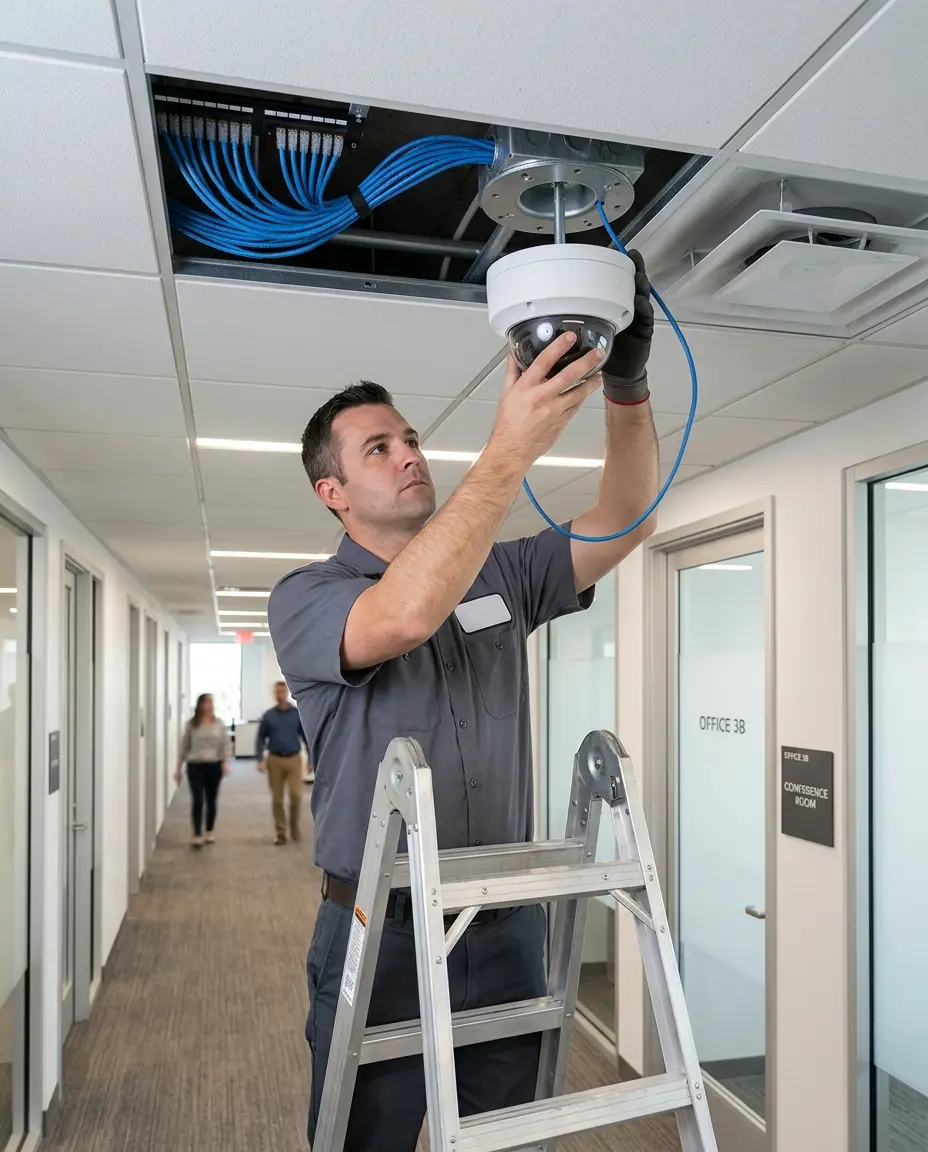
As a manufacturer-authorized dealer for Uniview and Avigilon, our technicians receive factory training on every camera model in both product lines. They know which sensor performs best in low light, which housing survives Canadian winters without fogging, and which lens configuration captures usable detail at the distances your facility requires.
Every camera comes with factory-backed warranties. When equipment issues arise, we handle the warranty claim directly with the manufacturer, including access to factory engineering support and priority replacement parts. And because Ainger installs both the cameras and the security wiring they connect to, the network infrastructure is specified for the exact video bandwidth each camera generates.
Client Testimonials
What Our Customers Have to Say



















Get a Quote for Your Surveillance Camera Project
READY TO START?
Every project starts with a site assessment. We’ll evaluate your facility’s environments, lighting conditions, and coverage requirements to recommend the right cameras for each position. No obligation, no pressure.
Request a QuoteFrequently Asked Questions
Yes. Commercial cameras use Cat6 network cable for both data and power (Power over Ethernet). Cable runs must be plenum-rated when routed through air-handling ceiling spaces. Cable quality, termination standards, and pathway routing directly affect whether cameras maintain consistent video quality or develop intermittent issues. Because Ainger installs both the cameras and the structured cabling, the network infrastructure is specified for the exact video bandwidth each camera generates.
Ainger is a manufacturer-authorized dealer for Uniview and Avigilon. Both manufacturers produce commercial-grade IP cameras across the full range of form factors including dome, bullet, PTZ, turret, and multi-sensor panoramic cameras. Authorized dealer status means factory-backed warranties, manufacturer-trained technicians, priority access to replacement parts, and direct escalation to manufacturer engineering support when complex issues arise.
Dome cameras mount flush to ceilings, provide wide-angle coverage, and resist tampering. They suit interior commercial spaces. Bullet cameras use a cylindrical housing with a longer-range focused lens and natural weather shedding, making them ideal for outdoor perimeters and parking areas. PTZ cameras provide remote-controlled pan, tilt, and optical zoom for covering large open areas where operators need to follow activity or zoom into distant details.
Resolution depends on what the camera needs to capture. 2MP (1080p) provides adequate identification at close range for interior hallways and offices. 4MP and 5MP cameras deliver sharper detail across wider areas and are the most common choice for commercial facilities. 4K (8MP) is reserved for high-value positions where facial detail or licence plate recognition at distance is critical. Specifying 4K everywhere increases storage and network costs without proportional benefit.
Camera count depends on facility layout, coverage requirements, and what the footage needs to capture. A small office might need 4-8 cameras covering entrances, lobbies, and server rooms. A warehouse may require 16-32 cameras for loading docks, floor areas, and perimeter coverage. The site assessment determines exactly how many cameras are needed and where each one should be positioned to eliminate blind spots without over-specifying.
Starlight is a sensor technology that produces full-colour video footage in near-darkness without requiring infrared illumination. Standard cameras switch to black-and-white night mode in low light, losing colour detail that can be critical for identification. Starlight cameras are recommended for parking lots, loading docks, warehouse interiors, and any location where lighting is inconsistent or limited. This is consistently the most underspecified feature in commercial surveillance projects.
Outdoor cameras need IP67 weatherproofing at minimum for Canadian climate conditions including snow, ice, and temperature extremes. Starlight or comparable low-light sensors are critical for areas without supplemental lighting. Bullet cameras suit fixed coverage positions along fence lines and building perimeters. PTZ cameras handle large surface lots where active monitoring is needed. Licence plate recognition at entry and exit lanes requires specific lens selection, mounting height, and angle calculations that are determined during the site assessment.
1996–2026

Contact Us
Get in Touch with Ainger Cabling + Security
Find Us Online