

Security Camera Installation & Wiring
for Commercial Facilities
What is Included in Commercial Security Camera Installation?
MANUFACTURER-AUTHORIZED CAMERA SYSTEMS
Ainger Cabling + Security provides manufacturer-authorized security camera installation and wiring for commercial clients across Canada and the United States. Because Ainger installs both the cameras and the structured cabling they run on, your wiring and your surveillance are designed as one system, by one team, to one standard. Our technicians install IP camera systems, CCTV surveillance, and perimeter security with factory-backed warranties from brands including Uniview, Avigilon, and DSC.
Every installation works reliably from day one, backed by 30+ years of commercial experience and 24/7 live monitoring capability. We serve facility managers, property directors, and business owners across eight commercial verticals from our Ottawa headquarters at 1742 Woodward Drive. A complete security camera installation project includes site assessment and system design tailored to facility layout, coverage requirements, and operational needs. Structured cabling installation uses commercial-grade cable management and concealment techniques.
IP camera or CCTV equipment installation from manufacturer-authorized brands (Uniview, Avigilon, DSC) integrates with network infrastructure including Power over Ethernet (PoE) switches and network video recorders (NVR). Testing and certification of all wiring and camera feeds ensure reliable operation. Factory-backed warranty registration and 24/7 live monitoring setup complete the installation, along with staff training on system operation and remote access configuration.


How Does Security Camera Wiring Differ from Standard Data Cabling?
Security camera wiring requires adherence to fire code and building code standards for low-voltage installations. Power over Ethernet (PoE) camera installations demand proper cable category selection (Cat6 or Cat6a) to support both data transmission and power delivery over distances up to 100 meters. Outdoor and perimeter camera wiring uses weather-rated cable with UV protection and conduit routing to withstand environmental exposure.
- Proper grounding and surge protection prevent equipment damage from electrical transients, especially critical for outdoor cameras.
- Cable routing must account for camera field-of-view requirements, avoiding obstructions and maintaining clean sightlines.
- Structured cabling standards (TIA-568) apply to security camera networks, ensuring scalability and future system upgrades.
- Because Ainger runs the cabling and installs the cameras with the same team, the wiring is specified for the exact cameras it will carry, with the right cable category, power budget, and routing planned from the start.
What Types of Commercial Security Camera Systems Does Ainger Install?
Our manufacturer-authorized dealer status for Uniview, Avigilon, DSC, and other brands ensures factory-backed warranties and compliance with commercial reliability standards:
- IP camera systems with network video recorders (NVR) for scalable, high-resolution surveillance across multi-building campuses.
- CCTV surveillance systems for facilities requiring analog camera infrastructure or hybrid analog-IP deployments.
- Perimeter security cameras with motion detection, infrared night vision, and weatherproof enclosures for outdoor monitoring.
- Remote video monitoring systems with cloud access for property managers overseeing multi-tenant portfolios.
- Wireless security camera systems for retrofit installations where running new cable is cost-prohibitive.
- Biometric-integrated camera systems that link facial recognition or card access events to video footage.
- 4K and high-definition camera installations for retail, healthcare, and industrial facilities requiring detailed forensic evidence.

Who Needs Professional Security Camera Wiring?
COMMERCIAL CLIENT SEGMENTS
Our security camera installation services serve commercial decision-makers across eight verticals, each with distinct surveillance requirements and compliance considerations:
- Facility managers and property directors overseeing commercial offices, warehouses, and multi-tenant properties who require reliable surveillance infrastructure and vendor accountability.
- Healthcare facilities (clinics, medical offices, long-term care) needing privacy-compliant camera systems that support Canadian health privacy requirements such as PHIPA in Ontario with secure storage and access controls.
- Hospitality properties (hotels, gyms, event venues) requiring guest safety monitoring, liability protection, and integration with access control systems.
- Retail and entertainment venues using camera systems for loss prevention, customer flow analysis, and incident documentation.
- Industrial facilities and manufacturing plants monitoring production areas, loading docks, and perimeter security.
- Schools and daycare centers implementing safety protocols with camera coverage of entry points, hallways, and outdoor play areas.
- Property management firms managing portfolios across multiple cities who need a single accountable partner for consistent system standards and 24/7 monitoring.
- Telecommunications infrastructure sites requiring remote monitoring of equipment rooms and tower access points.

How Does the Security Camera Installation Process Work?
STEP-BY-STEP PROJECT WORKFLOW
Initial consultation: We assess your facility layout, coverage requirements, compliance obligations, and integration needs with existing access control or alarm systems. System design: Our technicians create a camera placement plan with coverage maps, cable routing diagrams, and equipment specifications tailored to your operational needs.
Proposal and timeline: You receive a detailed scope of work, equipment list with manufacturer part numbers, and project timeline with minimal disruption to daily operations. Structured cabling installation: We run commercial-grade cable with proper concealment, labeling, and testing to ensure reliable data transmission and power delivery. Camera mounting and configuration: Technicians install cameras, configure network settings, integrate with NVR or cloud storage, and test all feeds for proper operation.
System testing and certification: We verify camera angles, motion detection zones, recording schedules, and remote access functionality before handoff. Staff training and documentation: Your team receives training on system operation, and we provide as-built documentation including cable maps and equipment manuals. Ongoing support: 24/7 live monitoring and maintenance services ensure your system works reliably beyond the initial installation.
What Are the Benefits of Power over Ethernet (PoE) for Security Cameras?
TECHNICAL & OPERATIONAL ADVANTAGES
Single cable simplicity
PoE delivers both data and power over one Cat6 or Cat6a cable, eliminating the need for separate electrical outlets at each camera location.
Centralized power management
PoE switches provide backup power through uninterruptible power supplies (UPS), ensuring cameras remain operational during power outages.
Scalability and remote management
Adding cameras to an existing PoE network requires only running a single cable to the nearest switch. Network administrators can reboot cameras remotely without dispatching technicians.
Compliance and cost efficiency
PoE installations follow TIA-568 standards, ensuring compatibility with future network upgrades. Eliminating dedicated electrical runs reduces labor and material costs, especially in retrofit installations.
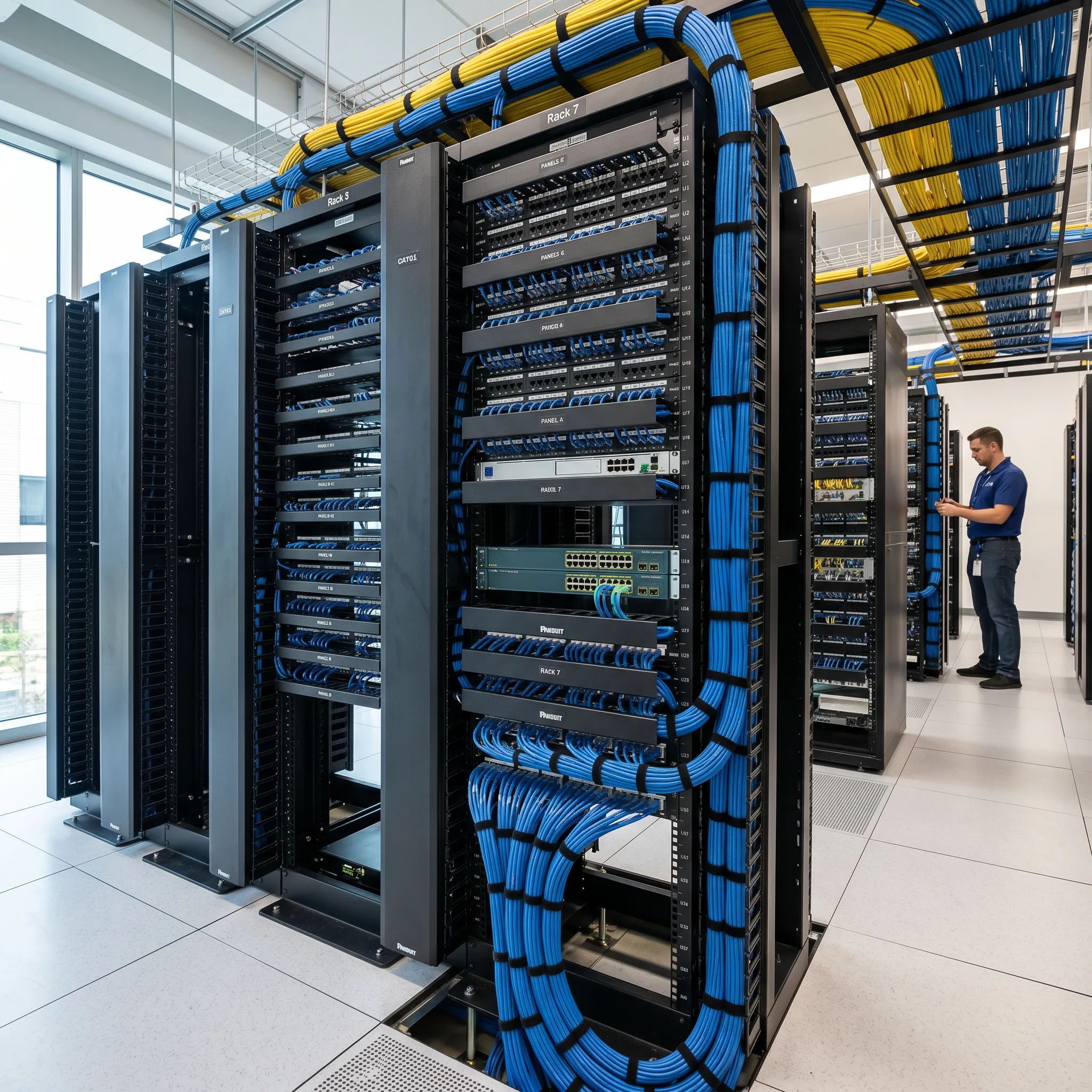
As a manufacturer-authorized dealer for Panduit structured cabling products, Ainger ensures PoE installations meet commercial reliability standards with proper cable category selection and power budgeting.
Client Testimonials
What Our Customers Have to Say




















Get a Quote for Your Security Camera Installation
READY TO START?
Every project starts with a site assessment. We’ll evaluate your facility, identify coverage requirements, and provide a detailed scope covering equipment, cabling, monitoring, and timeline. No obligation, no pressure.
Request a QuoteFrequently Asked Questions
During the site assessment phase, our technicians create detailed coverage maps showing camera fields of view, blind spots, and optimal mounting locations. We consider facility layout, entry points, high-risk areas, lighting conditions, and operational requirements specific to your industry. You receive a camera placement plan for approval before any installation work begins.
Installation timelines vary based on facility size and camera count, but most commercial projects are completed within 3-7 business days. We schedule work to minimize disruption to your daily operations, often performing installations during off-hours or weekends. Our project timeline includes structured cabling, camera mounting, system configuration, and staff training before final handoff.
All equipment comes with factory-backed warranties from manufacturers like Uniview, Avigilon, and DSC. If a camera fails, we handle the warranty claim process and provide replacement or repair service. Our 24/7 monitoring capability can detect camera failures immediately, allowing us to respond before you even notice an issue.
Absolutely. Our technicians routinely integrate camera systems with existing access control, alarm systems, and building management platforms. We design systems that link video footage to card access events, door openings, and alarm triggers for comprehensive facility security. Integration capabilities are assessed during the initial site consultation.
IP cameras transmit digital video over network infrastructure and offer higher resolution, remote access, and easier scalability compared to analog CCTV. CCTV systems use coaxial cable and dedicated video recorders, which can be more cost-effective for smaller installations or facilities with existing analog infrastructure. We install both types and can design hybrid systems that combine analog and IP cameras.
Yes, we offer 24/7 live monitoring and maintenance services to ensure your system continues operating reliably after installation. Our support includes remote troubleshooting, firmware updates, and on-site service when needed. Because the same team installs your system and maintains it, support calls go to the people who already know your facility rather than to a separate provider seeing it for the first time.
Yes, we serve commercial clients across Canada and the United States from our Ottawa headquarters. Our technicians travel to client sites for installation projects, maintaining the same quality standards and manufacturer certifications regardless of location. We work with facility managers and property directors managing multi-location portfolios.
In commercial environments, hardwired security infrastructure offers reliability advantages that wireless systems cannot match. Key benefits include:
- Simpler long-term serviceability. There are no batteries to replace across large numbers of devices, and the wired infrastructure scales cleanly as a facility adds cameras, readers, or sensors.
- A direct, consistent connection that does not rely on radio frequencies or wireless sensors. This reduces false alarms and removes the risk of signal interference or jamming, which matters for facilities that depend on continuous monitoring.
Wired security systems can cover large spaces, even spanning multiple buildings. Continuous wiring allows for signals to cross large spaces uninterrupted. They also allow for control panels and more sensors than typical wireless systems would be able to support. This provides more complete security for large spaces.
A wired security system is far harder to tamper with, because interfering with it requires physical access to the cabling itself. That takes more skill, time, and on-site presence than interfering with a wireless system, which makes a hardwired commercial installation a less likely target in the first place.
1996–2026

Contact Us
Get in Touch with Ainger Cabling + Security
Find Us Online