

Commercial CCTV Camera Systems
for Business Facilities
What Does a Commercial CCTV Camera System Include?
MANUFACTURER-AUTHORIZED VIDEO SURVEILLANCE
Ainger Cabling + Security delivers manufacturer-authorized CCTV camera systems for commercial clients across Canada and the United States, serving businesses for over 30 years. A commercial CCTV system is more than cameras on walls. It is an integrated platform comprising IP cameras, network video recorders, video management software, and the structured cabling infrastructure that connects everything together.
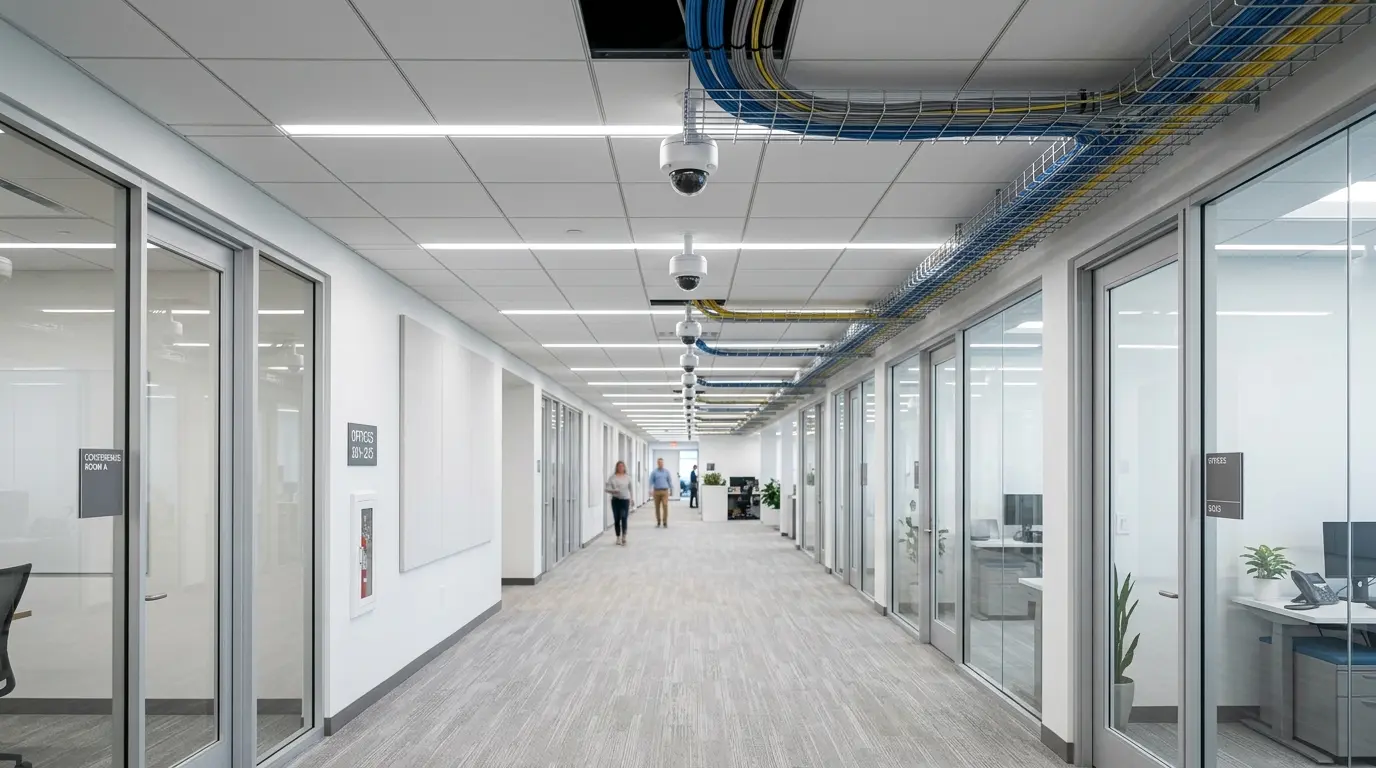
Our technicians install complete video surveillance systems from Uniview and Avigilon, including dome, bullet, and PTZ cameras, network video recorders with configurable retention schedules, and video management platforms that give facility managers live viewing, recorded playback, motion-triggered alerts, and remote access from any device. These systems integrate with access control, intrusion detection, and fire alarm systems under unified management.
Whether your facility needs four cameras covering a single entrance or a 200-camera enterprise deployment across multiple buildings, every installation is built on commercial-grade infrastructure designed for reliable 24/7 recording and long-term serviceability.

Who Needs a Commercial CCTV System?
Commercial CCTV systems serve businesses that need continuous visual documentation of their facilities for security, liability, and operational purposes:
- Commercial offices and corporate facilities monitoring lobbies, parking structures, server rooms, and common areas with camera coverage that provides both real-time awareness and recorded evidence for incident investigation.
- Warehouses and distribution centres covering loading docks, inventory areas, shipping lanes, and perimeter access points where theft prevention and operational oversight require continuous recording across large floor areas.
- Property management portfolios deploying standardized camera systems across multiple buildings with centralized video management, allowing property directors to monitor lobbies, hallways, parking garages, and common areas from a single platform.
- Healthcare facilities securing patient areas, pharmacy storage, emergency departments, and building perimeters with video systems that meet compliance requirements for patient privacy and evidence preservation.
- Retail and entertainment venues preventing theft, monitoring customer flow, and documenting incidents across sales floors, cash handling areas, storage rooms, and parking lots.
- Schools, daycare centres, and industrial facilities protecting students, staff, equipment, and operations with camera coverage designed for their specific environmental challenges and compliance requirements.
How Does a Commercial CCTV System Work?
A commercial CCTV camera system has four interconnected layers, and each one affects system performance:
- IP cameras capture the footage. Modern commercial systems use IP cameras that transmit digital video over the network. Different camera types suit different environments: dome cameras for interior ceilings, bullet cameras for outdoor perimeters, and PTZ cameras for large open areas requiring active monitoring.
- Network video recorders store and manage recordings. NVRs receive video streams from cameras over the network, store footage according to configurable retention schedules, and provide the playback and search interface. Storage capacity is sized based on camera count, resolution, frame rate, and how many days of footage you need to retain.
- Video management software ties everything together. VMS platforms from Uniview and Avigilon provide live viewing across all cameras, recorded playback with timeline scrubbing, motion-triggered event search, remote access from mobile devices, and integration triggers with access control and alarm systems.
- Structured cabling carries the data. Every camera connects to the NVR through the network cabling infrastructure. Cable category, pathway routing, PoE switch capacity, and VLAN segmentation determine whether cameras perform reliably or develop intermittent issues. Because Ainger installs both the cameras and the cabling, the infrastructure is specified for the exact video loads it will carry.

How Do CCTV Systems Integrate with Other Security Infrastructure?
INTEGRATED VIDEO SURVEILLANCE CAPABILITIES
A standalone camera system records footage. An integrated camera system becomes an active part of your security response:
- Access control events trigger video bookmarks. When someone presents a credential at a door, badges into a restricted area, or triggers a denied-access event, the nearest camera footage is automatically bookmarked. During an investigation, you pull up the door event and the corresponding video appears instantly.
- Intrusion alarms trigger camera recording. When a motion sensor or door contact trips after hours, cameras in that zone begin recording and the footage is flagged for immediate review. No more searching through hours of video to find the relevant clip.
- Video verification enables informed response. For sites with live remote video monitoring through Active Watch, monitoring operators can verify alarm events visually before dispatching emergency response, reducing false alarm costs and improving response accuracy.
- Remote mobile access keeps managers informed. VMS platforms provide live camera viewing and recorded playback on mobile devices, so facility managers and designated personnel can verify events and monitor their facilities from anywhere.
- Analytics extract operational intelligence. Commercial VMS platforms from Avigilon include AI-powered analytics for people counting, unusual motion detection, and object classification, turning passive camera footage into actionable operational data.

Why Choose Ainger for CCTV Camera System Installation?
YOUR SINGLE ACCOUNTABLE PARTNER
Camera system reliability depends as much on the network infrastructure as the cameras themselves. Insufficient PoE switch capacity, undersized network cable, or improper VLAN configuration cause dropped frames, degraded resolution, and recording gaps that only surface after the system is live. Because Ainger installs both the cameras and the network cabling they run on, the infrastructure is specified for the exact video bandwidth it will carry.
Our manufacturer-authorized dealer status for Uniview and Avigilon means factory-backed warranties on every camera, NVR, and VMS license. Technicians receive manufacturer training on camera placement, network configuration, and video management system programming.
When complex issues arise, we escalate directly to manufacturer engineering support. Independent contractors cannot offer that path. We also receive priority access to replacement equipment and firmware updates, reducing downtime during service calls.
One infrastructure partner. One accountability chain. One warranty behind everything we install.
How Long Does CCTV Camera System Installation Take?
PROJECT TIMELINES & SCHEDULING
Small camera systems
4-8 cameras with NVR typically complete within 2-3 business days, including cabling, camera mounting, system configuration, and remote access setup.
Mid-size deployments
12-32 cameras with VMS integration and access control linking typically require 1-2 weeks for cabling, installation, configuration, and commissioning.
Enterprise systems
50+ cameras with analytics, multi-building coverage, and full security system integration typically require 4-8 weeks with phased deployment to minimize operational disruption.
Multi-site rollouts
Standardized camera configurations deployed across multiple locations with centralized VMS access and coordinated deployment schedules.
Site assessment and system design typically require 3-7 days before installation begins. Camera placement, cable routing, NVR sizing, and network capacity planning are finalized during the design phase. Installations are scheduled to minimize disruption, with after-hours and weekend work available for occupied facilities.
Client Testimonials
What Our Customers Have to Say





















Get a Quote for Your CCTV Camera System
READY TO START?
Every project starts with a site assessment. We’ll evaluate your facility, identify coverage requirements, and provide a detailed scope covering cameras, recording, network infrastructure, and timeline. No obligation, no pressure.
Request a QuoteFrequently Asked Questions
Commercial IP cameras typically last 7-10 years, while NVR hardware may need replacement or upgrade every 5-7 years as storage demands grow. VMS software is updated through firmware and licence renewals. The structured cabling infrastructure underneath the system lasts 10-15 years when properly installed. We design systems with upgrade paths in mind so cameras and recorders can be replaced without replacing the cabling.
Yes. Commercial VMS platforms from Uniview and Avigilon provide secure remote access through desktop applications and mobile apps. Facility managers and designated personnel can view live camera feeds, play back recorded footage, and receive motion-triggered alerts from any device with an internet connection. Remote access is configured during system commissioning with user-level permissions to control who can view, play back, and export footage.
Storage requirements depend on camera count, resolution, frame rate, recording schedule, and retention period. A 16-camera system recording at 4MP and 15 frames per second typically requires 8-12TB for 30 days of retention. Higher resolutions and frame rates increase storage proportionally. During the design phase, we calculate exact storage requirements based on your cameras and retention needs, and size the NVR accordingly with room for future expansion.
When integrated, access control events automatically bookmark corresponding video footage. A denied credential at a door instantly surfaces the video from the nearest camera. Intrusion alarm triggers begin recording on cameras in the affected zone and flag the footage for immediate review. This integration is designed during the system planning phase and runs on the same structured cabling infrastructure, which is why having one vendor for both cameras and security hardware eliminates the coordination gaps that cause integration failures.
Traditional CCTV systems use analog cameras that transmit video over coaxial cable to a DVR. Modern IP camera systems use digital cameras that transmit video over network cabling (Cat6) to an NVR or VMS platform. IP systems offer higher resolution, remote access, analytics capabilities, and integration with access control and alarm systems. Most new commercial installations use IP camera systems, though existing coaxial infrastructure can often be reused during upgrades with hybrid DVR/NVR equipment.
In many cases, yes. Existing coaxial cable can support HD-over-coax cameras as an interim upgrade. For a full IP migration, the site assessment determines whether existing cable pathways can accommodate new Cat6 cabling alongside or in place of the old coax. We often phase IP migrations so the facility maintains camera coverage throughout the transition rather than going dark during a full replacement.
Yes. Ainger operates as an infrastructure partner, not a one-time project vendor. Maintenance agreements include periodic camera cleaning and angle verification, firmware updates, NVR health checks, and storage capacity monitoring. The same team that installed your system handles ongoing support, which means faster diagnosis and no learning curve on your facility. For sites requiring it, 24/7 live remote video monitoring through Active Watch is available as an additional service.
1996–2026

Contact Us
Get in Touch with Ainger Cabling + Security
Find Us Online