

Facial Recognition Security Systems
for Commercial Buildings
What Is Facial Recognition for Commercial Security?
MANUFACTURER-AUTHORIZED FACIAL RECOGNITION SYSTEMS
Ainger Cabling + Security installs facial recognition systems that integrate with commercial CCTV camera systems and access control infrastructure across Canada and the United States. As a manufacturer-authorized dealer for Avigilon and Uniview, we deploy facial recognition technology that enhances existing security systems with touchless access control, visitor management, and real-time alerting capabilities. Established 30+ years ago, we serve facility managers, property directors, and business owners who need a single accountable partner for both security systems and security wiring infrastructure, so the facial recognition hardware and the network it depends on are installed and supported by one team.
Facial recognition technology uses biometric analysis to identify individuals by mapping unique facial features captured by commercial surveillance cameras. The system compares live camera feeds against an enrolled database of authorized users, visitors, or persons of interest. Commercial facial recognition differs from consumer applications through higher accuracy requirements, integration with enterprise security platforms, audit trail generation for compliance, and deployment across multiple entry points or surveillance zones within a facility.
The operational benefits include touchless access control that eliminates credential sharing or loss, automated visitor check-in that reduces reception workload, real-time alerts when unauthorized individuals enter restricted areas, and post-incident investigation through searchable video archives. Every installation comes with factory-backed warranties from authorized brands including Avigilon and Uniview, all backed by certified technician training on commercial reliability standards.


How Facial Recognition Integrates with Commercial Security Systems
Commercial clients deploy facial recognition as an enhancement layer to existing security infrastructure rather than a standalone system:
- Access control integration: facial recognition readers replace or supplement card readers at entry points, granting access when enrolled faces are detected and logging entry attempts for audit trails.
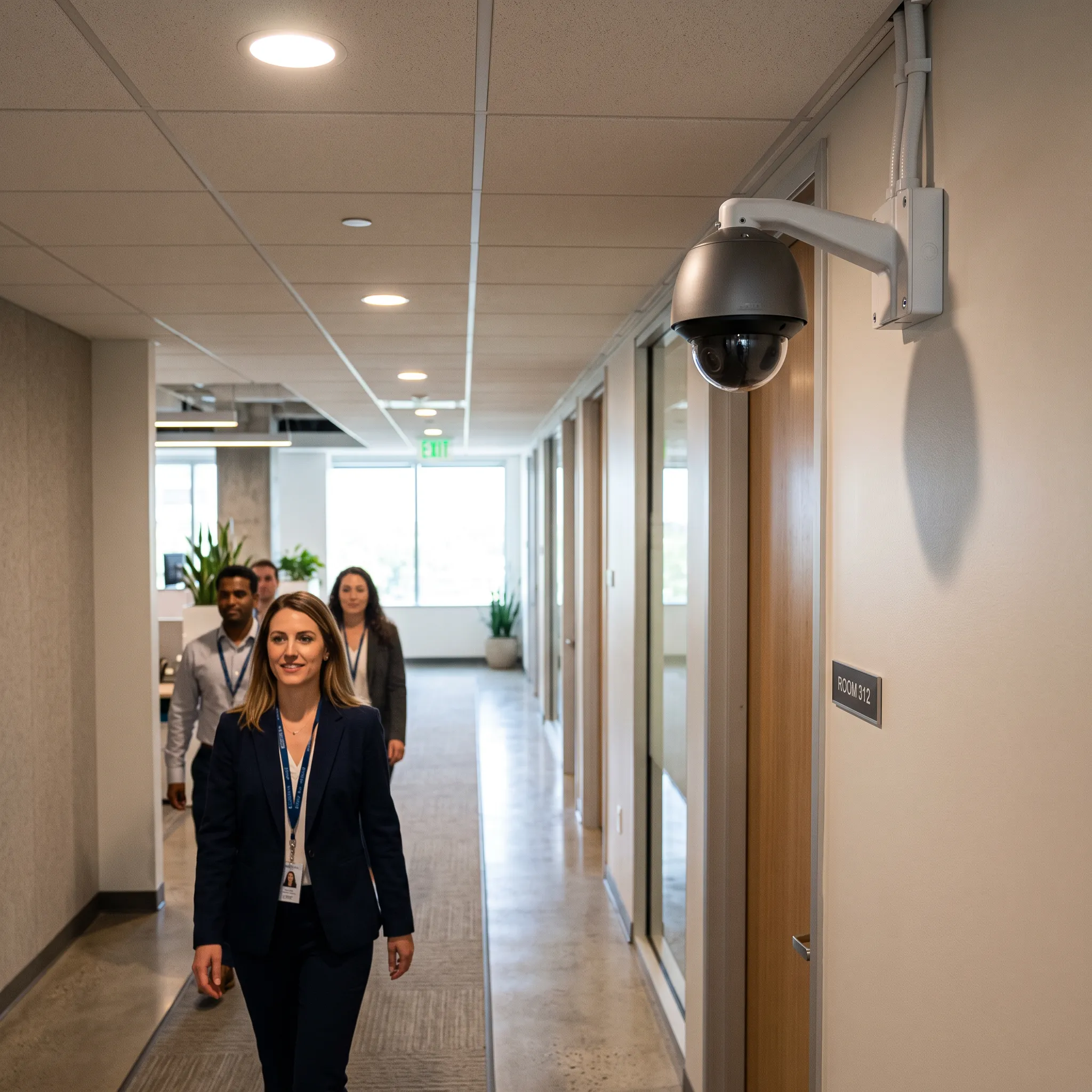
- Video surveillance analytics: existing CCTV cameras with facial recognition capability identify individuals in live or recorded footage, enabling searchable video archives and real-time alerts for persons of interest.
- Visitor management systems: front desk tablets capture visitor photos during check-in, automatically enrolling temporary credentials that expire after scheduled visit duration.
- Intrusion alarm integration: facial recognition systems communicate with alarm panels to disarm zones when authorized personnel enter, or trigger alerts when unrecognized faces appear in restricted areas.
- Time and attendance tracking: employee clock-in/out through facial recognition eliminates buddy punching and generates payroll-ready reports without physical timecards or badges.
Facial Recognition Use Cases in Commercial Buildings
Understanding deployment scenarios helps facility managers and business owners identify where facial recognition delivers measurable operational value:
- High-security area access: server rooms, pharmaceutical storage, executive suites, and research labs where biometric authentication prevents credential sharing or unauthorized entry.
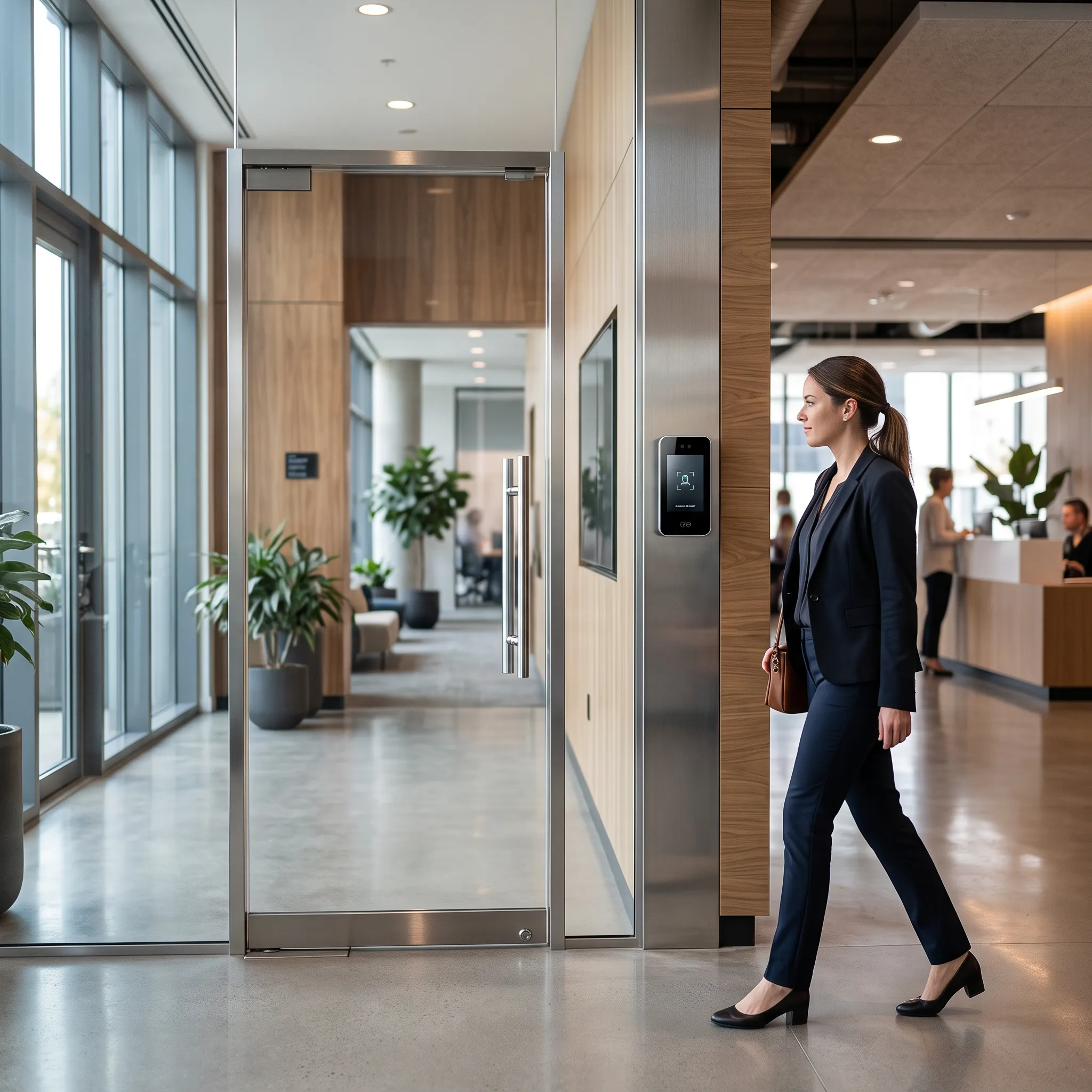
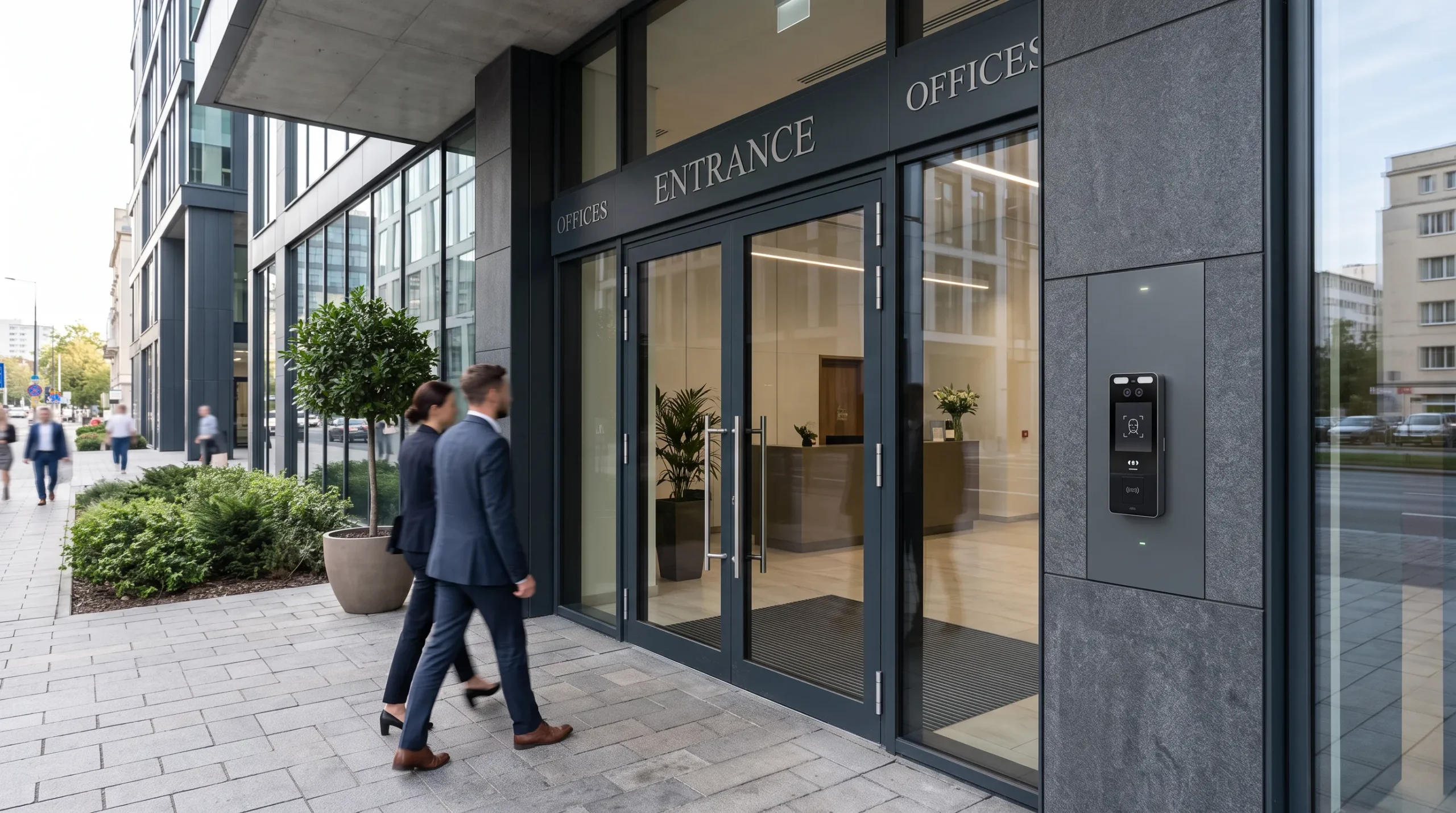
- Touchless building entry: main entrance access control that eliminates physical contact with card readers or keypads, reducing hygiene concerns and speeding entry during high-traffic periods.
- Visitor management and tracking: automated check-in at reception desks with photo capture, temporary credential provisioning, and real-time alerts when visitors enter unauthorized zones.
- VIP and executive recognition: automatic door unlock and elevator access for C-suite personnel without credential presentation, with discreet logging for security audit trails.
Accuracy Factors for Commercial Facial Recognition
TECHNICAL REQUIREMENTS FOR RELIABLE PERFORMANCE
Facial recognition accuracy depends on proper system design and environmental conditions that Ainger addresses during site assessment and installation:
- Camera resolution and positioning: minimum 2MP cameras mounted at optimal height (5-6 feet) and angle (10-15 degrees downward) to capture full facial features without distortion.
- Lighting requirements: consistent illumination across entry points with minimum 300 lux at face level, supplemented by IR illuminators for low-light or nighttime operation.
- Enrollment quality: high-resolution reference photos captured under controlled lighting with multiple angles to improve matching accuracy across varying conditions.
- Network bandwidth and latency: sufficient PoE switch capacity and network throughput to support real-time facial analysis without delays that impact access control response times.
- Database size and processing power: server or NVR specifications scaled to enrolled user count, with faster processors required for databases exceeding 1,000 faces.
- Environmental factors: indoor installations with controlled temperature and humidity to prevent camera lens fogging or condensation that degrades image quality.
Privacy Considerations and Compliance
RESPONSIBLE DEPLOYMENT PRACTICES
Ainger advises commercial clients on privacy best practices and regulatory compliance requirements that vary by jurisdiction and industry:
Data storage and retention: facial recognition databases stored on local servers or NVRs rather than cloud platforms to maintain data sovereignty, with retention policies aligned to business requirements and legal obligations. Consent and notification: visible signage at entry points informing individuals of facial recognition use, with opt-out procedures for visitors who decline biometric enrollment. Access control and audit trails: restrict system administrator access to authorized personnel only, with detailed logs of who accessed facial recognition data and when.
Industry-specific regulations: healthcare facilities protect biometric data under Canadian privacy laws such as PHIPA in Ontario, financial institutions follow GLBA guidelines, and multi-tenant properties address tenant privacy concerns through policy documentation. Data encryption: facial recognition templates encrypted at rest and in transit to prevent unauthorized access or data breaches, with secure credential management for system administrators.
What’s Included in Our Facial Recognition Installations
COMPLETE SYSTEM SCOPE
Facial recognition cameras and readers
Avigilon or Uniview cameras with built-in facial recognition capability, or dedicated facial recognition readers for access control integration at entry points.
NVR or server with facial recognition software
Processing hardware sized for enrolled user database and camera count, with facial recognition analytics software licensed for specified number of faces and concurrent streams.
Integration with access control or CCTV
API connections between facial recognition system and existing access control panels or video management software, with unified user interface for credential management.
Network infrastructure and cabling
Cat6 cabling for IP cameras, PoE switch capacity for camera power and data, and network bandwidth assessment to ensure real-time facial recognition performance.
Factory-backed equipment warranty (terms vary by manufacturer: Avigilon, Uniview), technician training on enrollment procedures and system operation, as-built documentation and admin credentials. Ongoing monitoring or maintenance requires separate service agreement.
Client Testimonials
What Our Customers Have to Say



















Get a Quote for Your Facial Recognition System
READY TO START?
Every project starts with a site assessment. We’ll evaluate your facility, identify facial recognition use cases, and provide a detailed scope covering cameras, integration, network requirements, and timeline. No obligation, no pressure.
Request a QuoteFrequently Asked Questions
Facial recognition requires cameras with minimum 2MP resolution positioned at specific mounting heights and angles to capture frontal facial geometry. Lighting conditions, camera-to-subject distance, and lens focal length all affect matching accuracy. Commercial systems from Avigilon include built-in analytics optimized for facial detection that account for these variables during the system design phase.
Yes. Facial recognition functions as an additional credential type alongside card readers, key fobs, and mobile credentials. It integrates with access control platforms like Kantech to provide touchless entry for enrolled personnel. Access rules, schedules, and zone permissions apply the same way as any other credential type, managed from the same software platform.
Modern commercial facial recognition systems from Avigilon achieve matching accuracy above 99% under proper conditions. Accuracy depends on camera placement, lighting, image quality, and the size of the enrolled database. Dual-factor authentication combining facial recognition with a second credential type is recommended for high-security applications where false acceptance must be minimized.
Facial recognition cameras capture facial geometry data from individuals entering monitored areas and compare it against an enrolled database. When a match is found, the system triggers a predefined action such as granting access, sending an alert, or logging the event with the corresponding identity. The entire process takes less than a second per face at commercial-grade processing speeds.
Facial detection identifies that a face is present in the camera frame. Facial recognition goes further by matching that face against a database of enrolled identities. Most commercial cameras include facial detection as a standard analytics feature for people counting and motion classification. Facial recognition requires additional software licensing and a properly maintained enrollment database.
Both. In access control mode, the system matches against an enrolled database and grants or denies entry. In surveillance mode, the system can detect and track unrecognized faces across multiple cameras, flag repeated appearances of unknown individuals, and alert operators to persons of interest. The two modes can operate simultaneously on the same camera system.
Commercial facial recognition in Canada must comply with applicable privacy legislation. Systems should only enroll individuals who have provided informed consent, stored facial data must be encrypted and access-controlled, and retention policies should be defined and documented. We design systems with privacy considerations built into the configuration rather than addressed after deployment.
1996–2026

Contact Us
Get in Touch with Ainger Cabling + Security
Find Us Online