

Structured Cabling Systems Built
for Commercial Reliability
What Is Structured Cabling and Why Commercial Facilities Need It
MANUFACTURER-AUTHORIZED COMMERCIAL INFRASTRUCTURE
Ainger Cabling + Security delivers manufacturer-authorized structured cabling installation across Canada and the United States, serving facility managers, property directors, and business owners who need infrastructure that works reliably from day one. As a Panduit-authorized dealer with 30+ years in commercial infrastructure, we design and install Cat5e, Cat6, Cat6a, and fiber optic systems that meet TIA/EIA standards and support your operational uptime requirements.
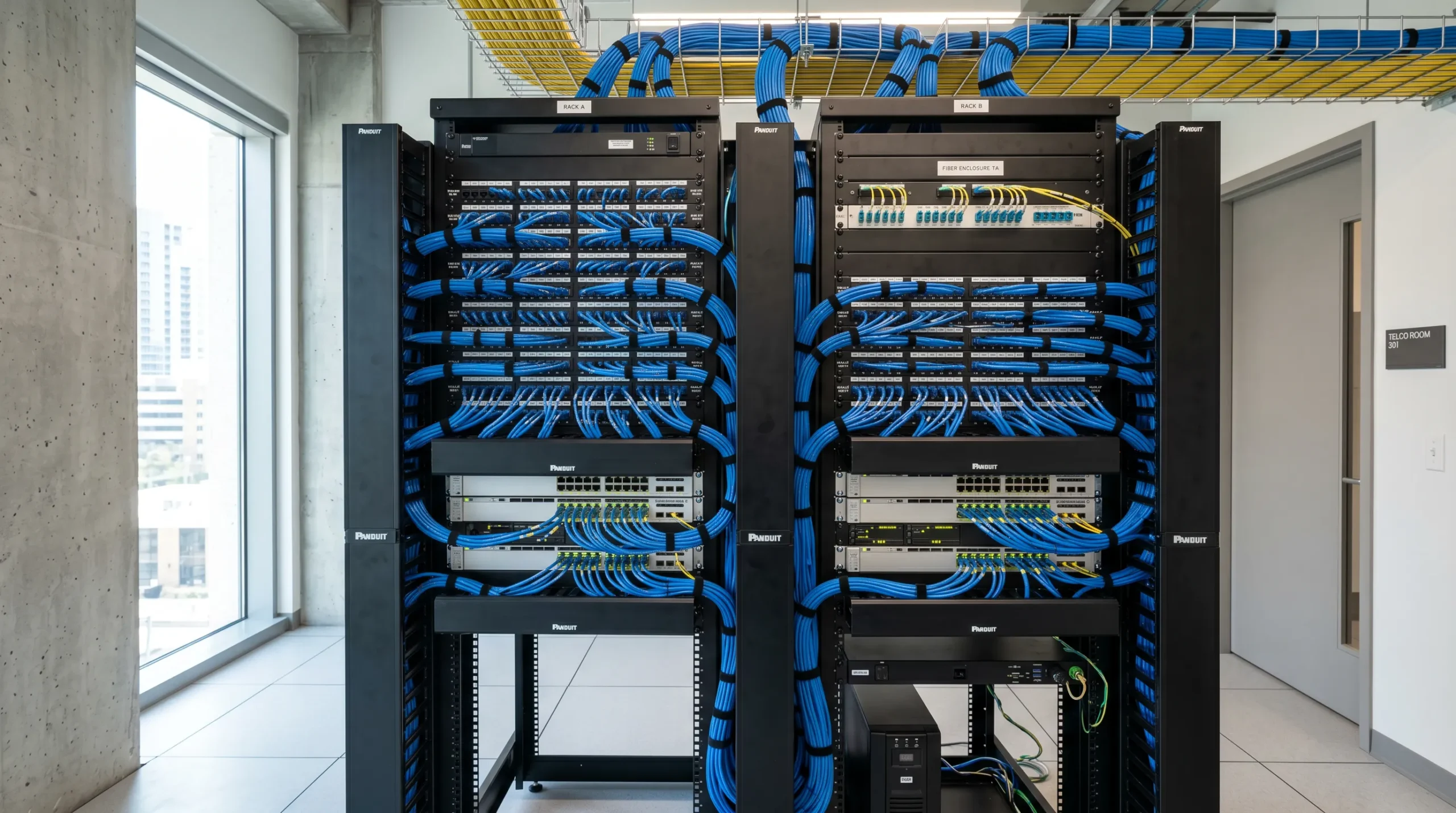
Structured cabling is the physical infrastructure that connects your entire network, including data, voice, video, and security systems, through a standardized architecture of cables, patch panels, and connectivity hardware. Unlike point-to-point wiring that creates a tangled web of connections, structured cabling organizes infrastructure into six subsystems: entrance facilities, equipment rooms, backbone cabling, horizontal cabling, telecommunications rooms, and work area components. This standardization means troubleshooting is faster, expansions are simpler, and you’re not locked into proprietary vendor equipment.
For commercial facilities, properly designed structured cabling eliminates network bottlenecks, supports business-critical applications, and scales with your organization without requiring infrastructure overhauls. Your VoIP phones, IP cameras, access control panels, wireless access points, desktop computers, and server infrastructure all depend on the same physical layer. When that layer is designed correctly, your IT team spends less time troubleshooting connectivity issues and more time supporting business operations. When it’s designed poorly, you face network downtime, troubleshooting delays, inability to add devices, and failed building inspections.
Cable Types and Performance Standards for Commercial Networks
Commercial facilities require different cable types depending on bandwidth requirements, distance limitations, and environmental factors. Understanding the performance specifications helps you choose infrastructure that supports current operations and future growth:
- Cat5e supports 1 Gbps to 100 meters — sufficient for general office desktop connectivity and VoIP phones, but limited for high-bandwidth applications or future 10 Gbps upgrades.
- Cat6 supports 10 Gbps to 55 meters and 1 Gbps to 100 meters — the standard choice for most commercial offices, providing headroom for bandwidth growth without the cost premium of Cat6a.
- Cat6a supports 10 Gbps to 100 meters — recommended for data centers, high-density environments, and facilities planning to support 10 Gbps network equipment in the next 5-10 years. Better shielding reduces crosstalk in high-density cable bundles.
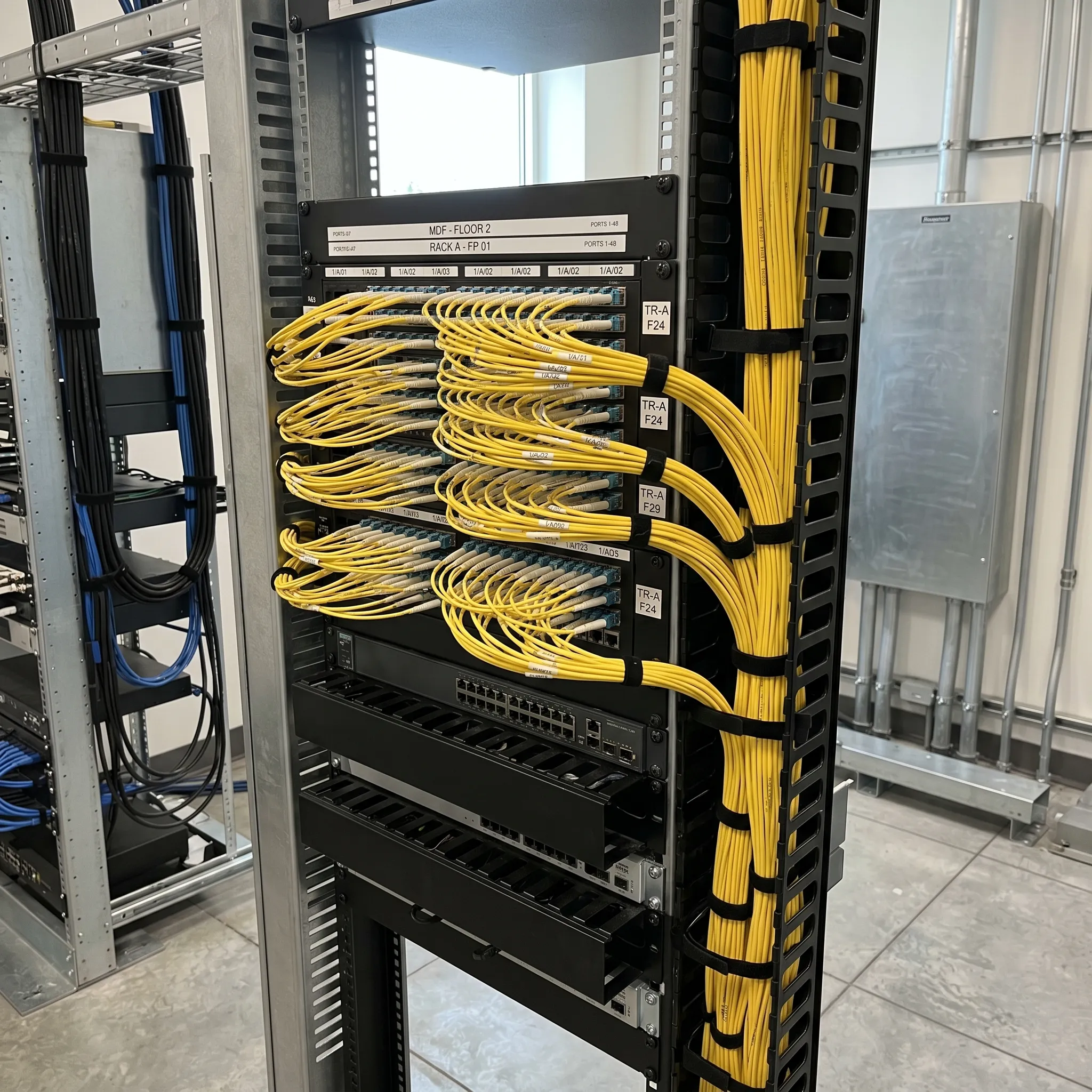
- Fiber optic supports 10 Gbps+ over long distances — used for backbone connections between buildings, telecommunications room interconnects, and applications requiring immunity to electromagnetic interference.
- Shielded twisted pair (STP) vs unshielded (UTP) — shielding matters in high-EMI environments like industrial facilities with heavy machinery, but adds cost and installation complexity for standard office environments.
- Power over Ethernet (PoE, PoE+, PoE++) — properly installed Cat5e, Cat6, and Cat6a all support PoE for powering IP cameras, wireless access points, and VoIP phones through the same cable that carries data, simplifying installation and enabling centralized power backup.
- TIA-568 wiring standards — compliance with industry standards ensures performance specifications are met, activates manufacturer warranties, and provides a common framework for troubleshooting and expansion.
How Structured Cabling Installation Works for Commercial Projects
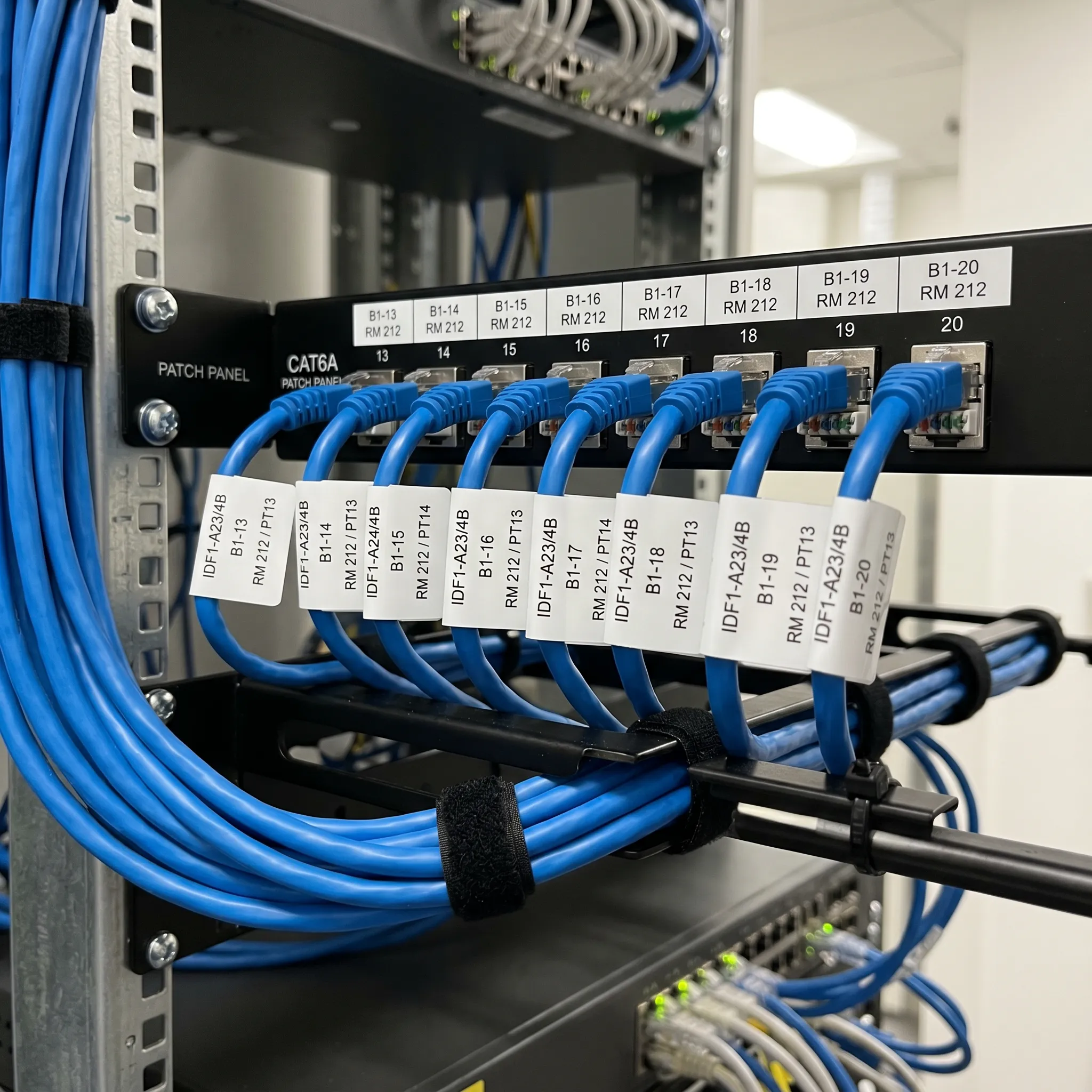
Every structured cabling project starts with a site assessment. We evaluate your facility, count devices, review existing infrastructure, and assess telecommunications room capacity. This assessment informs the design phase where we map cable pathways, plan rack layouts, organize patch panel configurations, establish labeling schemes, and verify TIA compliance.
- Installation includes cable pulling, termination, patch panel mounting, testing, labeling, and documentation. Small offices with 20-30 data drops typically take 2-3 days. Mid-size facilities with 100-150 drops require 1-2 weeks. Large campus projects with multiple buildings can take several weeks depending on scope and coordination with other trades.
- Certification testing uses Fluke equipment to verify performance specifications. Test reports document that every cable run meets TIA standards, activating manufacturer warranty protection and providing compliance documentation for building inspections.
- Documentation deliverables include as-built drawings, cable maps, test reports, and labeling legends. Proper documentation is critical for troubleshooting, future expansions, and warranty compliance.
- One team installs cabling and security together. Because Ainger installs both the structured cabling and the security systems that run on it, the cabling is specified for the systems it will carry rather than handed off between separate contractors.
Structured Cabling Integration with Security and Network Systems
UNIFIED INFRASTRUCTURE FOR MULTIPLE SYSTEMS
Structured cabling supports IP-based security systems including IP cameras, access control panels, intercom systems, and intrusion detection devices. Power over Ethernet delivers both data and power through a single cable, simplifying installation and enabling centralized power backup for security devices. Network segmentation using VLANs separates camera traffic, access control networks, and guest Wi-Fi on the same physical infrastructure without security compromises.
- One accountable team across cabling and security. Because Ainger installs both the structured cabling and the security systems that run on it, one team can diagnose whether an issue sits in the cabling, the equipment, or the network configuration.
- Wireless infrastructure depends on properly designed cabling. Strategic access point placement, PoE power distribution, and backbone capacity for wireless traffic all require structured cabling designed to support wireless density and coverage requirements.
- Building automation systems run on the same infrastructure. HVAC controls, lighting systems, and energy management platforms all connect through structured cabling, creating a unified physical layer for multiple building systems.
- Proper cabling design supports future technology changes. Installing Cat6a today provides headroom for 10 Gbps network equipment tomorrow without requiring infrastructure replacement. Adding fiber backbone capacity supports long-distance connections and high-bandwidth applications as facilities grow.
- Conference room AV systems require dedicated cabling. Audio visual cabling for displays, projectors, and control systems integrates with structured cabling infrastructure to support presentation technology and digital signage distribution.
- Incremental migration from legacy systems is possible. Analog security systems can be migrated to IP-based platforms over time without requiring full replacement, protecting existing investment while upgrading capability as budget allows.
Our Results Installing Structured Cabling for Commercial Clients
30+ YEARS SERVING FACILITY MANAGERS
Ainger Cabling + Security has delivered structured cabling installations for commercial clients across Canada and the United States for over 30 years. Our typical projects include office expansions requiring 50-200 data drops, warehouse facilities needing backbone fiber connections, and multi-tenant properties standardizing infrastructure across multiple floors.
Common challenges we resolve include legacy cabling causing network slowdowns, unlabeled patch panels creating troubleshooting delays, and insufficient cable pathways limiting the ability to add devices. As a Panduit-authorized dealer, every installation includes factory-backed warranties on all installed cabling components, ensuring long-term reliability and manufacturer support.
The operational outcomes from properly designed systems include reduced IT support calls, faster device deployment, simplified vendor management, and compliance with building codes. Our bilingual project coordination serves English and French-speaking commercial clients across Ontario and Quebec, with established coverage in Ottawa, Toronto, Montreal, Quebec City, and Gatineau.
Structured Cabling for Specific Commercial Verticals
VERTICAL-SPECIFIC INFRASTRUCTURE REQUIREMENTS
Commercial offices and warehouses
Desktop connectivity, wireless access point distribution, VoIP infrastructure, conference room AV support, and backbone capacity for business-critical applications.
Healthcare facilities
Privacy-compliant network segmentation (PHIPA, HIPAA), nurse call integration, medical device connectivity, and EMI considerations in imaging areas requiring shielded cabling.
Industrial facilities
Shielded cabling for high-EMI environments, ruggedized connectors, fiber for long warehouse runs, SCADA system support, and infrastructure designed for harsh conditions.
Property management portfolios
Standardized infrastructure across multiple buildings, centralized telecommunications rooms, tenant handoff points, and scalable design for multi-tenant properties.
Each vertical has distinct infrastructure requirements. Retail and entertainment venues need POS system connectivity and digital signage distribution. Schools and daycare centers require classroom technology support and administrative network separation. Hospitality operators need guest Wi-Fi backbone and property management system connectivity. We design structured cabling systems that meet vertical-specific requirements while maintaining TIA standard compliance.
Client Testimonials
What Our Customers Have to Say



















Schedule a Structured Cabling Assessment
READY TO START?
Every project starts with a site assessment. We’ll evaluate your facility, count devices, review existing infrastructure, and provide a detailed scope covering cable types, pathways, telecommunications room requirements, and timeline. No obligation, no pressure.
Request an AssessmentFrequently Asked Questions
A properly installed structured cabling system typically lasts 15-20 years or longer with minimal maintenance. Cat6 and Cat6a copper cabling can support multiple generations of network equipment upgrades without replacement, while fiber optic infrastructure often exceeds 25 years of service life. Regular inspections and documentation updates help maximize your infrastructure investment.
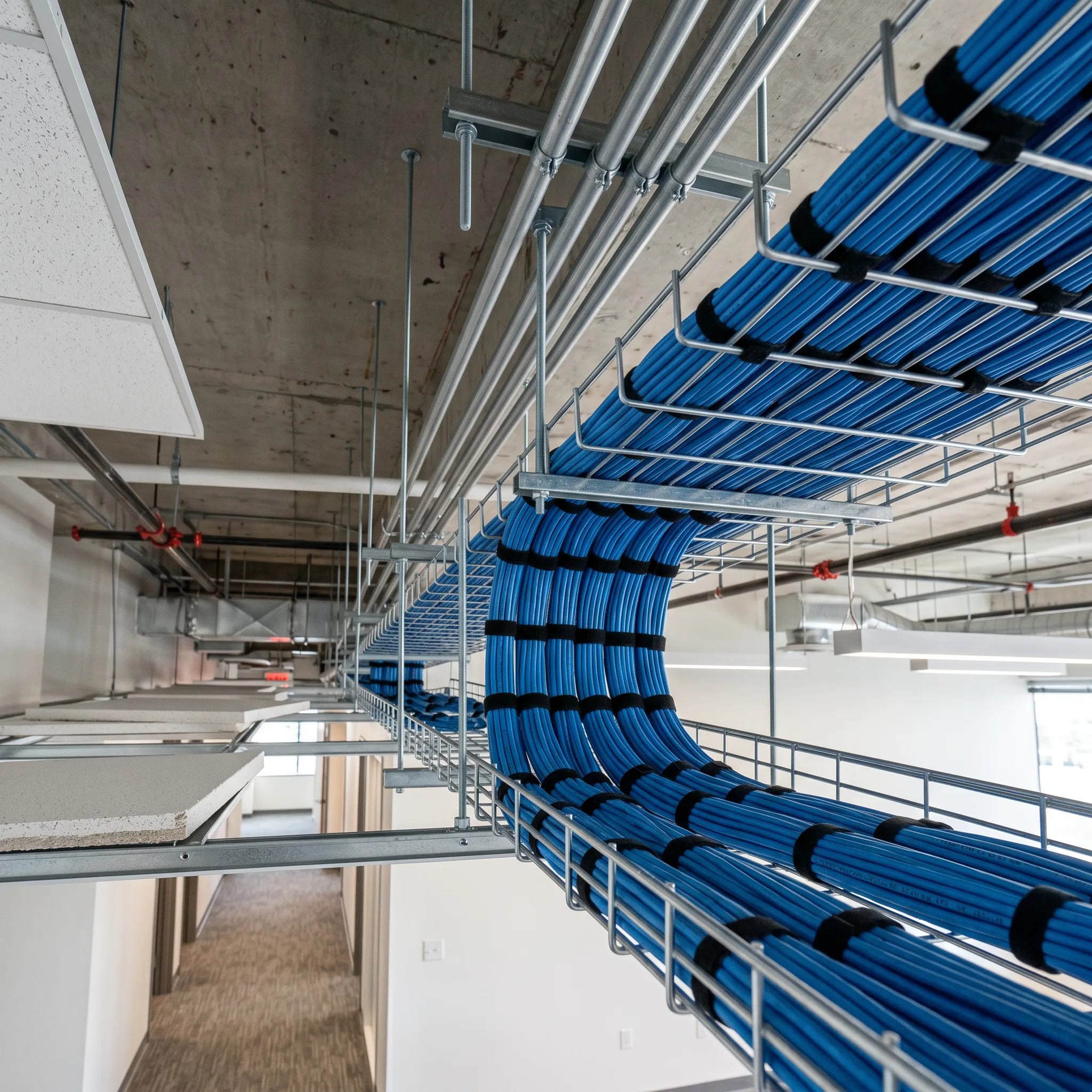
Yes, structured cabling can be retrofitted into existing buildings using various installation methods. We can utilize existing conduit, install surface-mount raceways, use plenum-rated cables in drop ceilings, or employ cable trays to avoid major construction. Our site survey identifies the most cost-effective pathways that minimize disruption to your operations.
A telecommunications room is a dedicated wiring closet that houses patch panels, network switches, and cable terminations for that floor or zone. Multi-story facilities typically need a TR on each floor due to the 90-meter horizontal cabling distance limit specified in TIA-568 standards. Smaller single-floor facilities may only require one equipment room.
Yes, Ainger provides ongoing maintenance, troubleshooting, and support as your infrastructure partner beyond project completion. We can perform adds/moves/changes as your facility evolves, conduct periodic testing to verify continued performance, and respond to connectivity issues. Our bilingual support team serves commercial clients across Canada and the United States.
Damaged cables can be identified quickly using certification testing equipment and documentation showing exact cable routes. In most cases, individual cable runs can be replaced without disrupting the entire system, thanks to the modular design of structured cabling. Panduit-certified installations include manufacturer warranty coverage on materials, and our team handles troubleshooting and repairs.
Power over Ethernet delivers both data and electrical power through the same Ethernet cable, but higher-power PoE standards require quality cabling to handle increased heat and power delivery. Cat6a cabling is recommended for facilities planning extensive PoE deployment with devices like PTZ cameras, high-power wireless access points, or LED lighting. Proper cable bundling and heat dissipation considerations are addressed during design.
Structured cabling uses a standardized architecture organized into six subsystems, making troubleshooting faster and expansions simpler without vendor lock-in. Point-to-point wiring creates tangled connections that are difficult to trace, modify, or troubleshoot when problems occur.
Certification testing uses specialized equipment to verify every cable run meets TIA performance standards. Test reports document compliance, activate manufacturer warranty protection, and provide required documentation for building inspections, ensuring your infrastructure performs as specified.
Installation timelines depend on facility size and scope. Small offices with 20-30 data drops typically take 2-3 days, mid-size facilities with 100-150 drops require 1-2 weeks, and large campus projects with multiple buildings can take several weeks depending on coordination requirements.
Yes, structured cabling systems are designed for incremental upgrades. You can migrate from analog to IP-based systems over time, add fiber backbone capacity as needed, or upgrade specific cable runs while keeping existing infrastructure intact, protecting your investment while expanding capability.
Yes, structured cabling provides a unified infrastructure for data, voice, video, security cameras, access control, and building automation systems. Power over Ethernet can deliver both data and power through a single cable for devices like IP cameras and wireless access points, simplifying installation and enabling centralized backup power.
Most standard office environments work well with unshielded twisted pair (UTP) cabling. Shielded twisted pair (STP) is recommended for industrial facilities with heavy machinery or high electromagnetic interference environments, though it adds installation complexity and cost.
Cat6 supports 10 Gbps speeds up to 55 meters and is suitable for most commercial offices, while Cat6a supports 10 Gbps to the full 100-meter distance with better shielding to reduce interference in high-density environments. Cat6a is recommended for data centers and facilities planning for long-term bandwidth growth.
You’ll receive comprehensive documentation including as-built drawings, cable maps showing every connection, certification test reports proving TIA compliance, and labeling legends. This documentation is essential for troubleshooting, future expansions, warranty compliance, and building inspections.
1996–2026

Contact Us
Get in Touch with Ainger Cabling + Security
Find Us Online